Afini – Learning Finance Made Fun
Ishita Arora
Afini is an educational game app aimed at tackling the lack of financial literacy among university students. The app combines theoretical learning with gameful, interactive experiences, allowing users to build financial knowledge and apply it in a low-stakes, engaging environment that encourages practical understanding and confidence.
Timeline
September – December 2023
Role
UI/UX designer, Service designer
Tools
Figma
What problem am I trying to solve?
7 in 10 Canadians consider themselves to be financially illiterate, and 53% of Canadians were never taught financial management in school.
What is the gap in the current system?
It isn’t the lack of resources to learn but rather the overwhelming abundance of information and the absence of clear starting points.
The app and its features
Onboarding
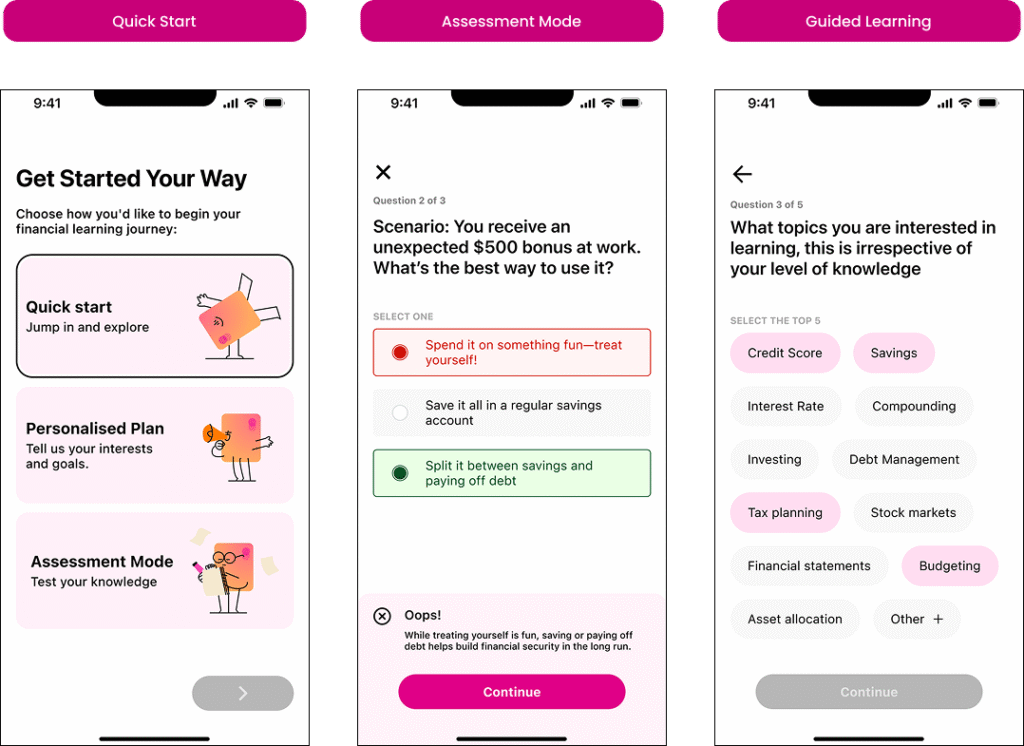
Some users said things like “I want to learn this” or “I want to focus on topics that are relevant to me.” Others approached it from a different angle—wanting to assess what they already know so the app could tailor content accordingly. Each option reflects a different user mindset and helps create a more meaningful, customised experience from the start. The 3 ways of onboarding the user are: quick start, personalised plan, and assessment mode.
Gameplay 1
Tinder swipe
The swipe interactions draw inspiration from dating apps like Tinder—something widely familiar and popular among university students.
Because the interaction model is already ingrained in other apps Genz used, it helped lower the cognitive load and made learning feel more playful and casual, rather than formal and rigid.
Gameplay 2
Scenario-based
The credit card flow was designed as a low-stakes way for users to apply theoretical knowledge to real-world scenarios. It provides a safe space for exploration, with quick feedback loops that mimic real-life situations, without the actual risk.
This kind of simulation-based approach is already a common tool in finance education, and through my interviews, I found that it remains one of the most effective ways to balance engagement with educational value.
Gameplay 3
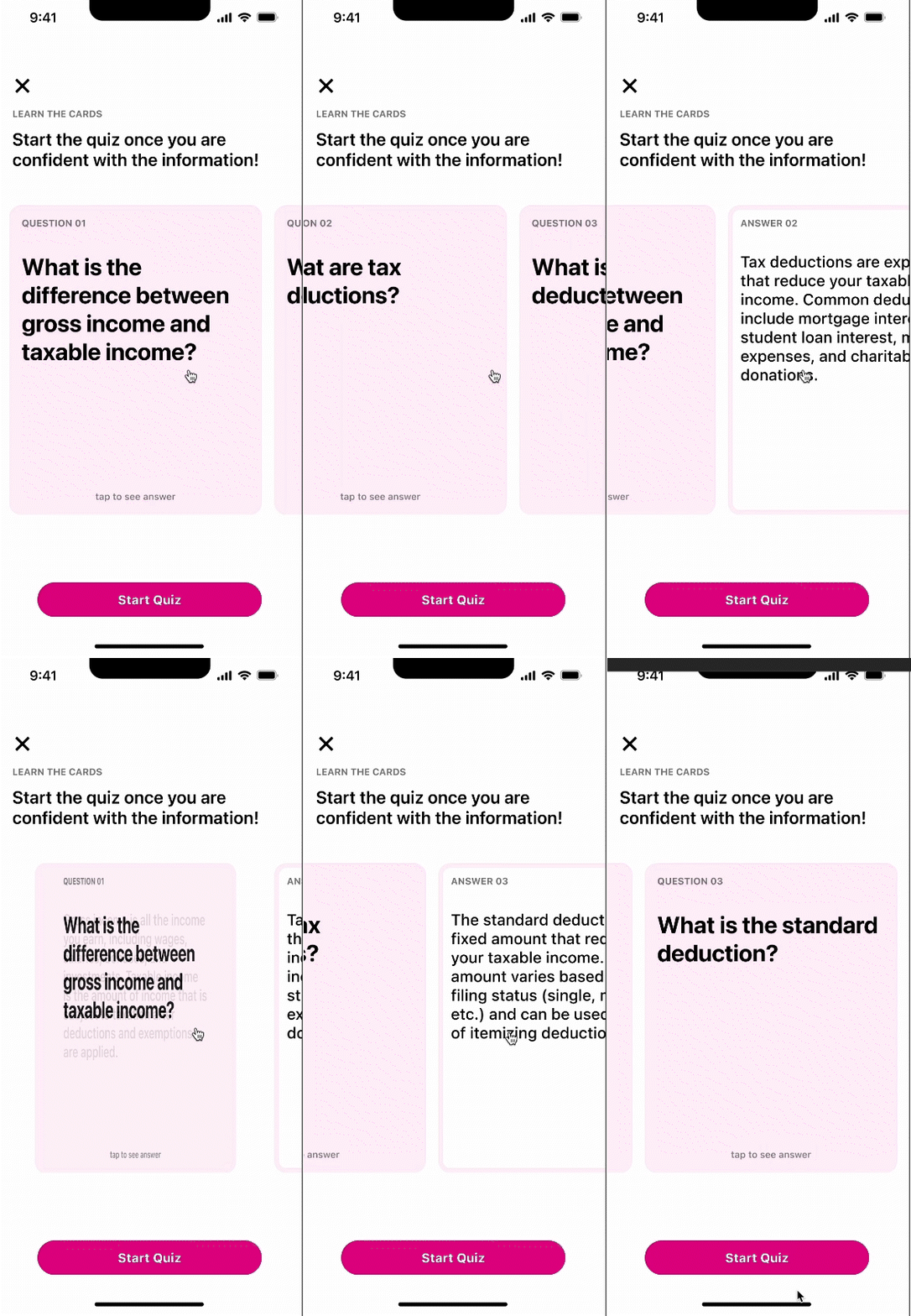
Flashcards
The app needed to feel interactive and playful without resembling traditional learning. Retention was crucial, so I focused on balancing fun with effectiveness. Early feedback showed users didn’t want to feel tested, leading me to design subtle, infrequent assessments based on research into knowledge retention.
For the flashcards, I created a familiar, low-pressure flow that minimised cognitive load while reinforcing key concepts, keeping the experience light, natural, and effective.
Gameplay 4
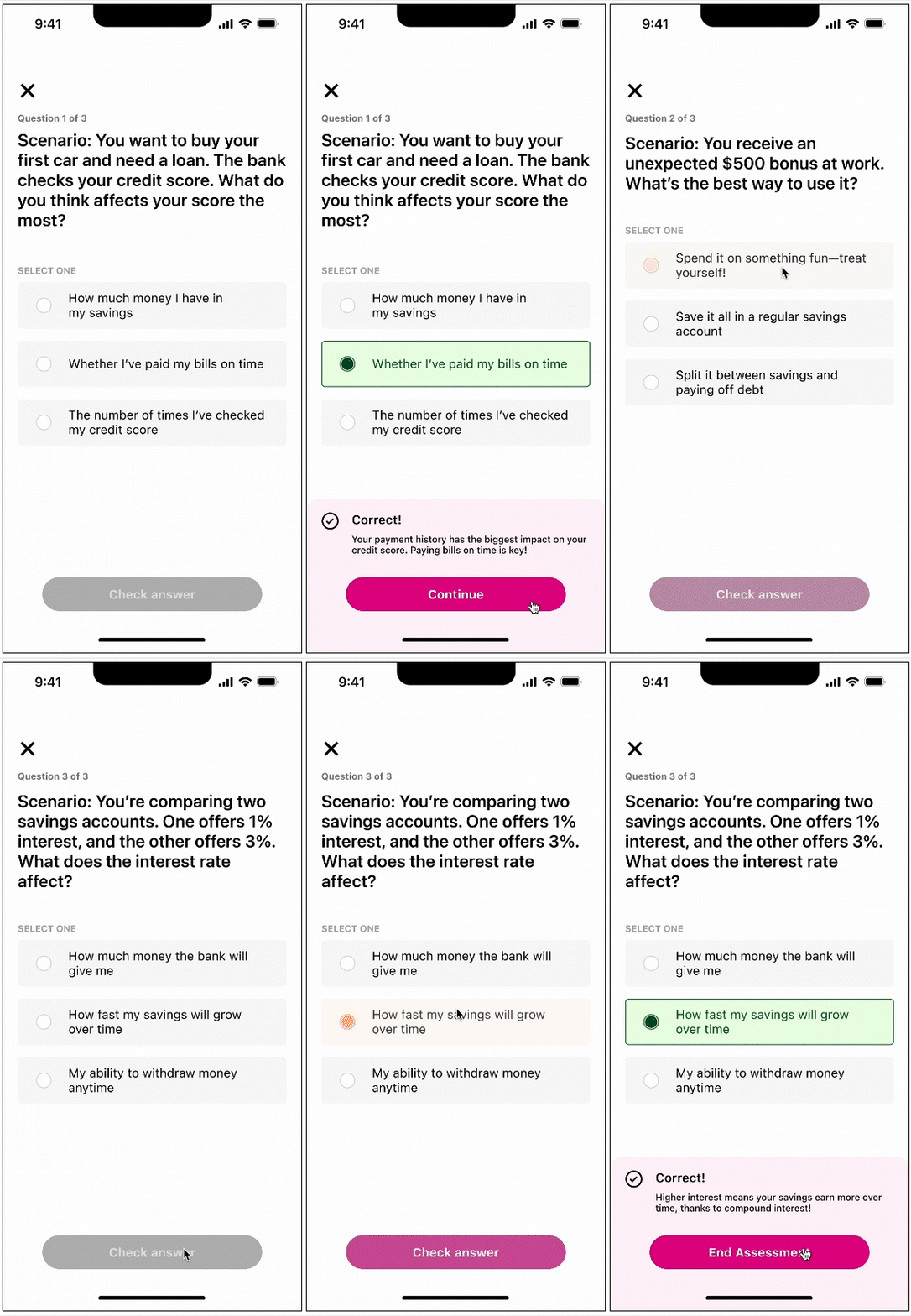
Quizzes
For the quizzes, I followed a similar philosophy. I kept them short and spaced out, ensuring they didn’t feel overwhelming or punitive. The goal was to encourage reflection and recall without triggering test anxiety.
During later testing, we discovered that many users preferred being gently nudged toward the right answer rather than having it revealed immediately. Others, however, found overly vague hints frustrating. To meet both needs, I designed two learning pathways: one offering discovery through soft prompts and another providing more direct support when necessary.
Mascot & components
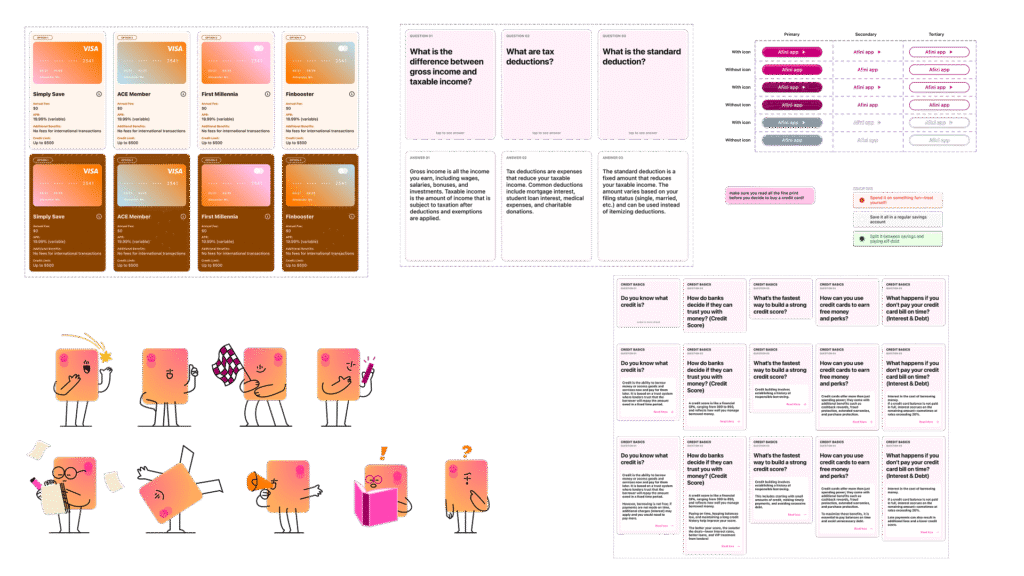
I created a full style guide and component system for the app for consistency across the app. To give the app more personality, I also designed a mascot: Afini, a credit card character that reflects the user’s emotions. Inspired by Duolingo, Afini helps keep the app playful and relatable.
Potential Impact: If the app is used, here is what happens

Responsible
Demonstrating financial responsibility fosters stability. Actively managing finances builds habits for independence.

Clarity
Knowing where money goes and how to optimise spending gives users control and enables smarter decisions.

Empower
The app helps users gain financial confidence and eventually move beyond it through a strong onboarding system.