Invisible Labour Loops
Jen McGowan
See it On Campus: Level 2
Located in the Libby Leshgold gallery
Visitor Info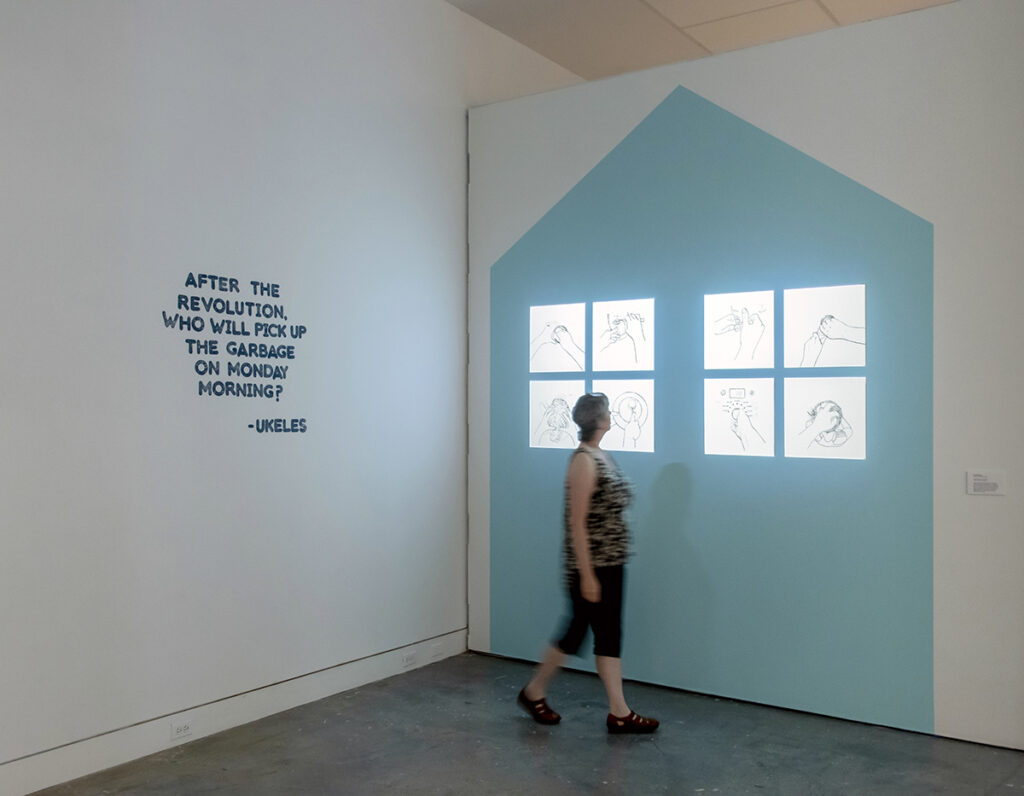
“Motherhood, it could be said, is the unfinished business of feminism” – Dr Andrea O’Reilly
“Maintenance is a drag; it takes all the f*cking time” (lit.) – Mierle Laderman Ukeles
My work begins with the autobiographical and considers how my lived experience of caretaking intersects with the broader societal forces acting upon motherhood. Invisible Labour Loops represents the never-ending domestic tasks that keep a family maintained. This project reflects my pandemic-fueled awareness of how patriarchal, capitalist society exploits unpaid domestic and care labour. I draw attention to the persistent undervaluing of invisible labour by representing the repetitive daily routines caregivers do in the privacy of their homes. To do this, I captured my hands performing circular tasks and rotoscoped (traced) a portion of the action that could be looped indefinitely. The digitally drawn line abstracts my hand, transforming it into a symbol of a caregiver who is not me, yet is also me. The graphic abstraction further seeks to suggest a broader connection between the undervaluing of maternal care labour and the exploitation of invisible labour performed by “outsourced” and marginalized persons. To expand the project expressly beyond myself I included the hands of other carers in the same style. I then arranged all the loops to project into the windows of a house-shape on the gallery wall. The project’s form reflects its content: the never-ending loops represent the drag on the time and energy of those who provide care, as well as the persistent and historical undervaluing of domestic and care labour.
This project is indebted to the prior work of intersectional feminist artists and scholars, who have framed the portrayal of maternal identity and the undervaluing of care work within the political context of their time. Invisible Labour Loops seeks to reanimate a rich, creative, and theoretical archive in a contemporary context. This thesis work reframes the ongoing devaluation of maternal care work in the socio-political framework of the post-pandemic moment.