Dwelling Grounds
Sar Nordstrom
See it On Campus: Level 1
Dwelling Grounds is in the sculpture studio.
Visitor InfoThis work was created on the unceded ancestral land of the xʷməθkʷəy̓əm (Musqueam), Sḵwx̱wú7mesh Úxwumixw (Squamish) and səl̓ilw̓ətaʔɬ (Tsleil-Waututh) peoples.
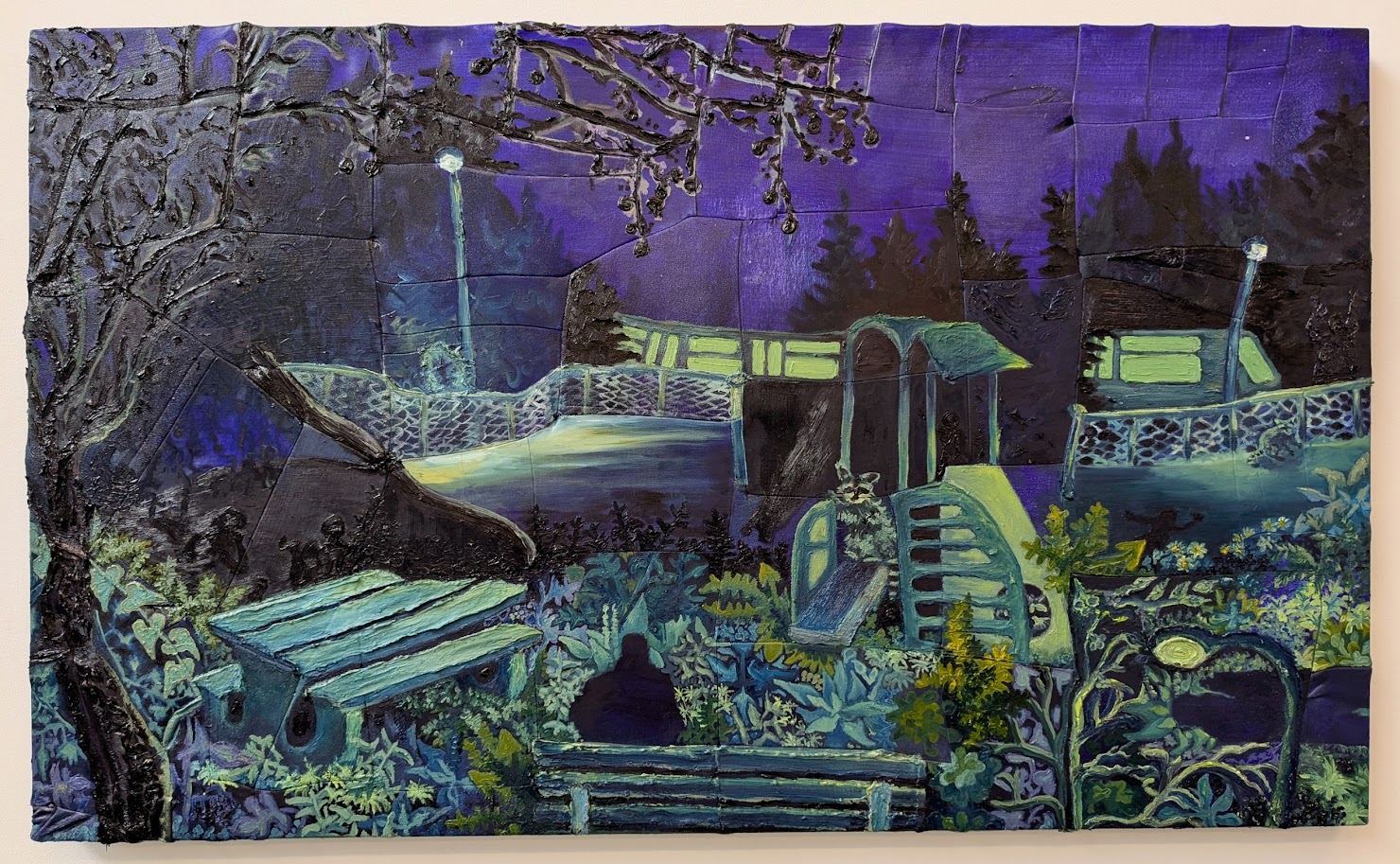
Dwelling Grounds, 2025, oil paint on sewn scrap fabric, 36 x 60 inch
Dwelling Grounds is a quilted painting exploring what lives between the seams of old haunts. There is a park that I often frequent during transient hours, occupied by a myriad of lawn grasses, epiphyte vines, large fruiting trees and old conifers. People and animals alike visit these grounds, leaving imprints of themselves behind on worn benches and in abandoned seed shells between phone calls to loved ones and in moments of reprieve from harsher city streets. This painting is an investigation of these hauntings, these inhabitations.
Feeding off the river wetland paved over and redefined are dandelion, crabgrass, fescue, plantain, white clover, creeping buttercup, morning glory, red flowering currant, English ivy, nightshade, hawthorn, apple, red cedar and pacific hemlock. Raccoons, birds, people, rats and house cats find shelter beneath cedar branches as the train glides by. All these living beings tell stories, histories and mythologies of their own as they find their way here from across the city and across the globe. I am making a reparative endeavor to sew together this terraformed landscape of the old and the new, invasive, native and migrant, piecing together what it means to be ever-transforming and alive on this land.
Cultivating Trans–
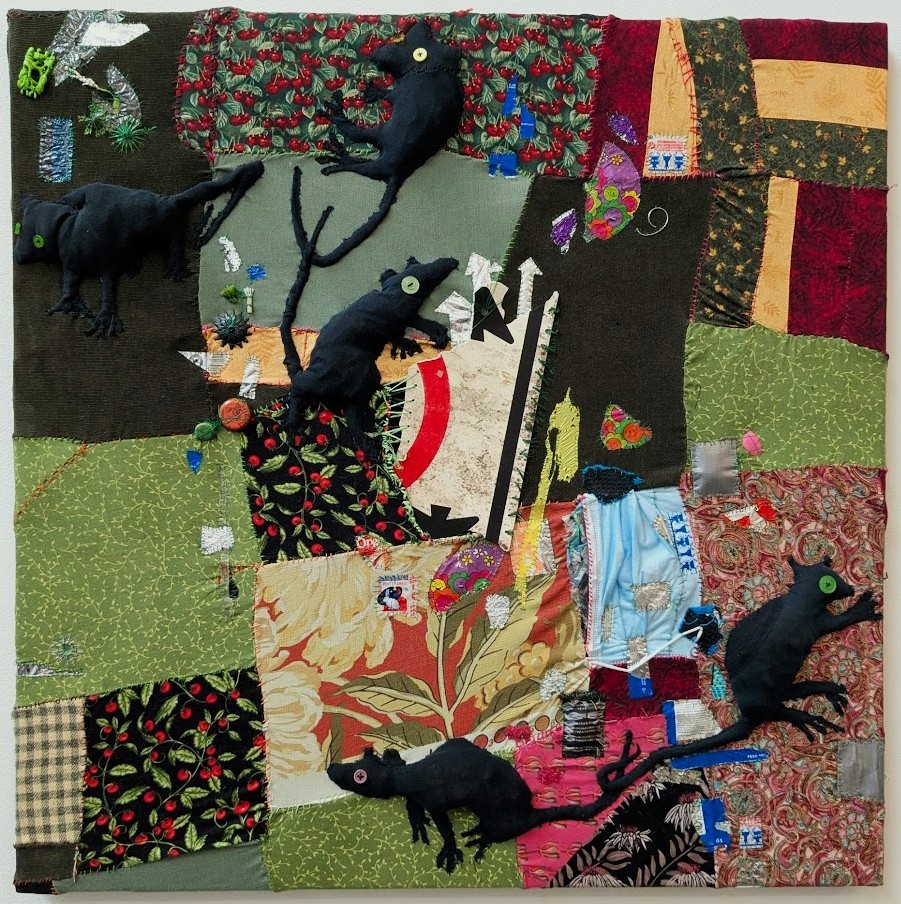
Rat Nest, 2025, found fabric, thread, buttons, and garbage sourced from woods, 30 x 30 inch
I am thinking of bridges, transversing, translation, transference. I am thinking of metamorphosis, transformation, transplantation. I am thinking of liminal spaces, transience, transection. I am thinking of transition.
The trans- is a concept I have been developing throughout the semester as I knit the threads of my practice together. How do these: material, gender, flora, fauna, funga, body, intersection and gathering place tie together? In answering this question I expand my own definition of what it means to be trans, taking the prefix trans- to describe what is in-between; to transform, transfigure, transmute; to translate, transcribe, transmit, transfer; to transgress and transplant, to be transitive. It is the space between translation, the process of transition, the potential of transformation, the place where textile meets paint, where skin touches skin, where human reaches animal reaches plant, transience and transcendence, the intersection we meet each other at and the intersection where no one meets anyone, the outcast, the liminal, waiting rooms and public parks, the moments between me and you. In this way, trans- becomes praxis.
In Dwelling Grounds’ series, Eva Hayward’s investigation into trans* resonates with queer ecological themes I am reaching towards. She writes, “Geopolitical trauma is the landscape through which trans* and animals meet. These habitats are neither the apocalyptic vistas of ecological destruction nor the quaint harbors of biocultural hope. Trans* meets animals not in the ‘posthuman’ moment or in the ‘Anthropocene’—terms that have come to define academic cliques that are often immured from the extremes of this dying planet—but in a time of trans*life.”1
With Hayward’s “tranimalities” in mind, I am caught by the work of Uýra Sodoma,2 an indigenous artist from Mojuí dos Campos, Santarém in the Amazon forest whose performance art obscures what is flesh, plant, animal, human, forest, native, nature, garbage and invasive. She often situates himself in active landscapes of geopolitical trauma, spaces defined by the amalgamation of garbage and forest. Inseparable from body, they become the forest.3 Inseparable from nature, we undergo transformation.
Rat Nest took shape alongside Dwelling Grounds with the desire to depict a tactile physicality of the ecological trans-. Thinking of Uýra Sodoma and of Eva Hayward’s trans*, I collected garbage from the woods at PKOLS, washed it tenderly and sewed it into collected scrap fabrics. Just as birds collect animal fur, twigs and strings of plastic to line their nests, by paying attentive care to the trash I collect I am thinking of possible futures ground in the reality of soil and water and new forms of care inseparable from the world that we live with.
Conceptual Development
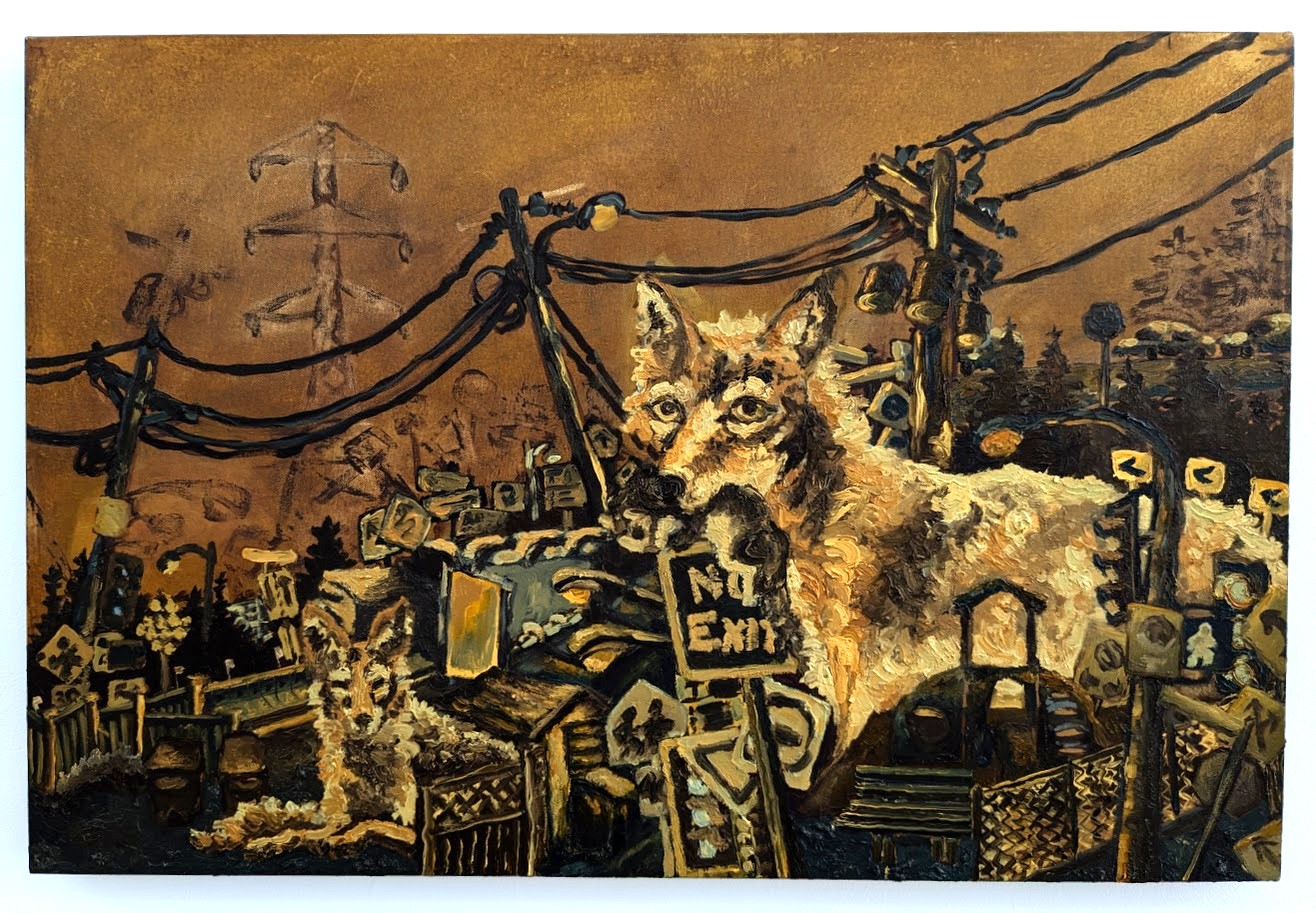
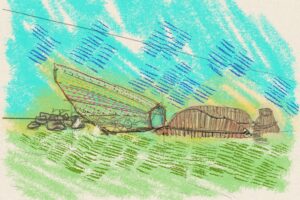
Coyotes at Night, 2024, oil on canvas, 26 x 36 in.
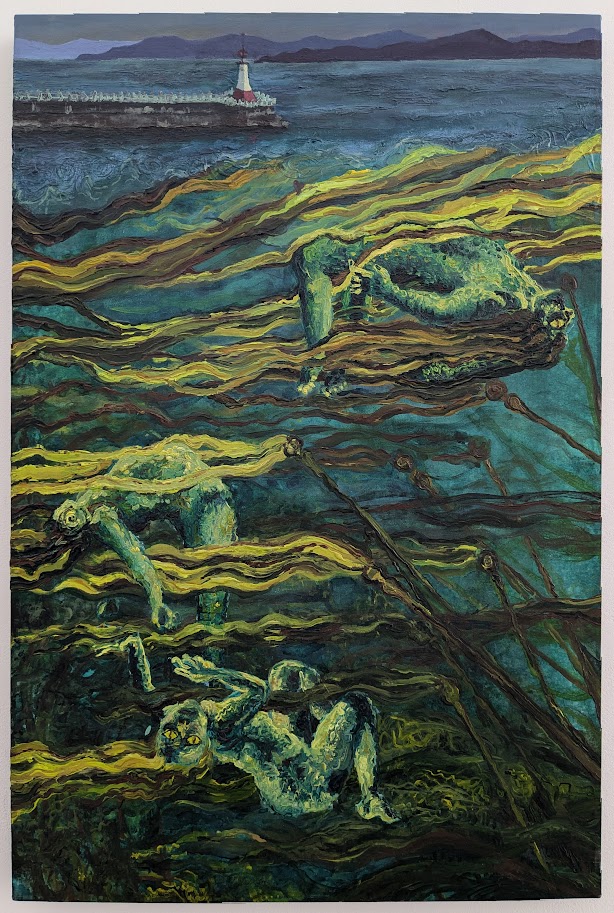
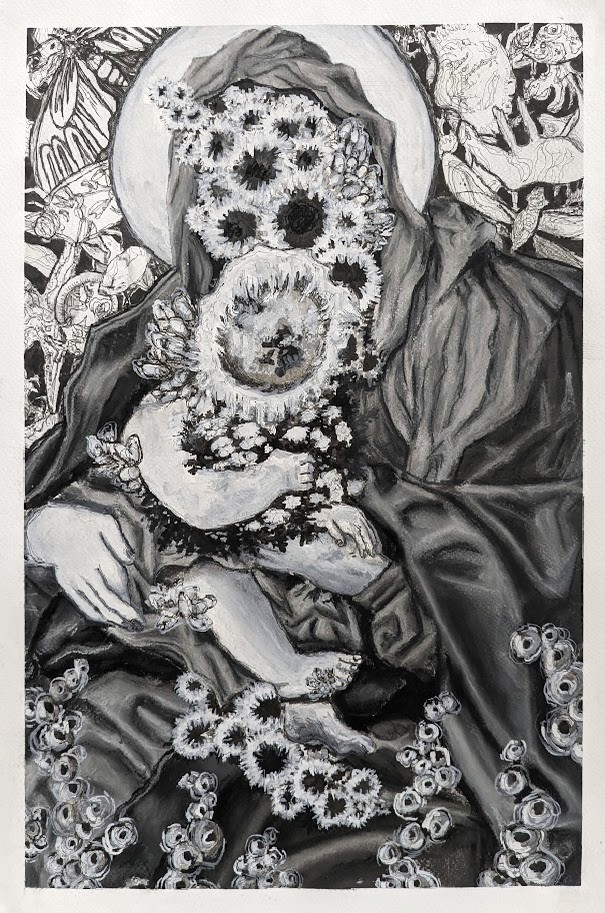
Ogden’s Curse, 2024, acrylic on canvas, 36 x 26 in. and Madonna and Child, 2023, pen, ink, charcoal, chalk pastel, 26 x 18 in.
Coyotes at Night, Ogden’s Curse and Madonna and Child all depict an intersection of the natural and the anthropocentric. In Coyotes at Night, a pair of coyotes move through a city drenched in streetlight and shadow. After humans, these urban-adapted dwellers are the apex predators of the city’s ecosystem, remnants from the forest that once sat situated on this land. Ogden’s Curse is born from a childhood ghost story invented about kelp being akin to hair adrift at sea, women dragging sailors to their drowned depths. However, in its painted retelling I am thinking about missing and murdered Indigenous girls and women, the violent British fur trader, explorer and settler that the point was named after, and bull kelp forests that are desperately trying to stay alive in polluted waters. Madonna and Child is overtaken by other city-dwelling flora and fauna, anemones, deer, bugs and barnacles. They stress an inseparability of the human from the natural world, of creation and steward, of what keeps living despite all that has died. These are all early iterations that play with similar themes as Dwelling Grounds and indicate a process of learning an ever-changing and ever-growing ecological knowledge of the unceded land that we live on, presently known as British Columbia.
Material Process
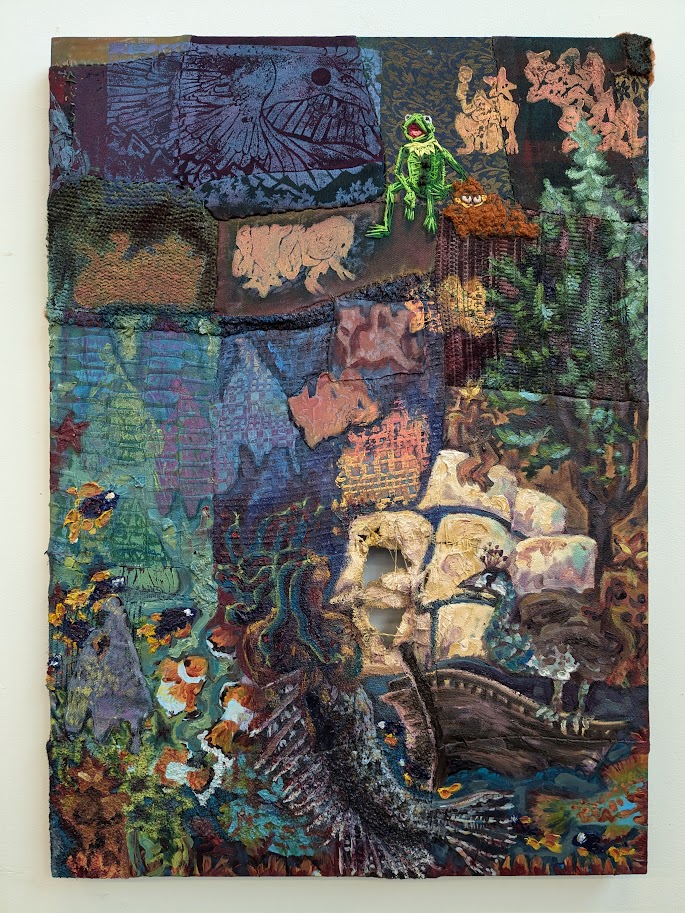
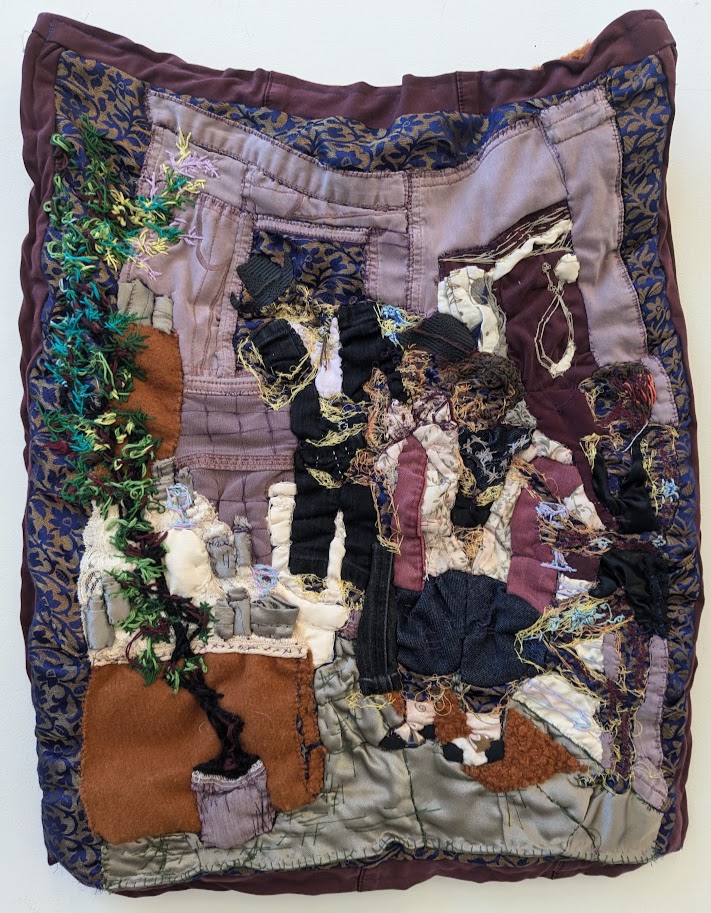
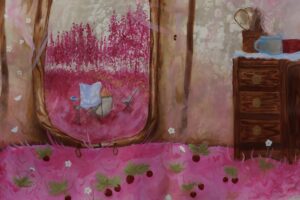
Where is Your Body?, 2024, acrylic and oil on patchwork fabric, 35 x 25 in. and Gathering Place, 2024, fabric and embroidery, 24 x 18 in.
Where is Your Body? And Gathering Place are an exploration of materials, gender and queerness. As a material exploration, they heavily inform the physical process of Dwelling Grounds‘ series. Where is Your Body? collects imagery sourced from other trans and gender-nonconforming individuals in regard to their experience with gender. It places cultural icons, mythology, sex-changing fauna and flora in conversation with one another. I experimented with stretching hand-sewn patchwork fabric on a canvas frame, painting and printing linocuts over its various textures and patterns and involving acts of social practice in my process. Gathering Place comes from a further personal place and investigates queer dynamics of care in the domestic sphere, caught in the act of transformation in concert with one another. It is also the first piece of mine that exclusively uses fabric and embroidery in its material process.
Throughout history, textiles become an integral part of defining culture, class and gender. Traditionally, fibre art has been defined by women in the domestic sphere while painting has been reserved for men in professional high art and intellectual circles. By combining fibre arts and painting, I am queering both practices, situating my work in a trans* in-between space, textile becoming both queer and ancestral. Fibre art as queer practice embeds itself in works such as the AIDS Memorial Quilt, the exhibition Queer Threads: Crafting Identity and Community, alongside cultural touchstones like drag balls, Gilbert Baker’s original pride flag and queer signalling through subversions of fashion. Fibre art as ancestral embeds itself in the work of my grandmothers and their mothers before them and their mothers before them.
Final Thoughts
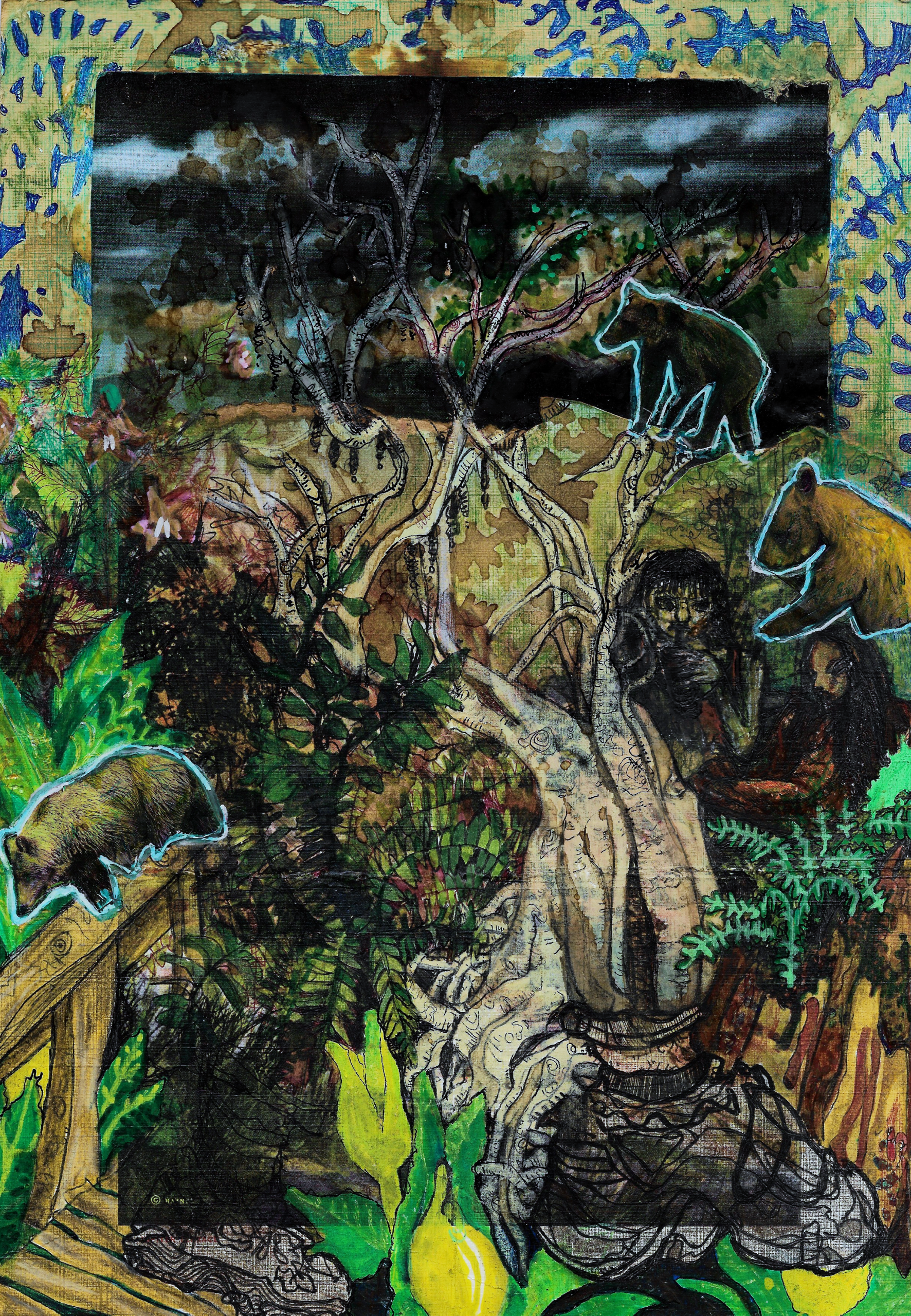
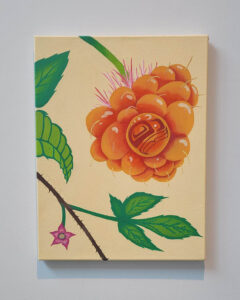
Ravine, 2025, pen, marker, acrylic ink, alder ink from ravine on paper, 8 x 11.5 in.
Ravine is a drawing that emerged after my textile work of the semester and illustrates the themes of Dwelling Grounds through alder and fern. The ravine is returning to a forested state within the city and allows a glimpse of what a reforesting Vancouver riverbank looks like: ornamental hedge laurels mixed amongst invasive blackberry and native salmonberry. Ultimately, the ravine is a space for city-dwelling creatures, people and plants. The bear is displaced and we amalgamate. Yet kinglets dive for flies over the water while hummingbirds and robins flit among branches. Alder trees, skunk cabbage and horestail reclaim the mud. Ink is created from the bark of a fallen tree that will carry on to feed the riverbank soil. We tell stories and buy groceries. This is one moment in our ever worldy transition. Where shall we transform to?
1 Hayward, Eva, and Jami Weinstein. 2015. “Introduction: Tranimalities in the Age of Trans* Life.” TSQ: Transgender Studies Quarterly 2 (2): 195–208. https://doi.org/10.1215/23289252-2867446.
2 Terra, Nathalia, Adamo da Veiga and Thiago Ranniery, “Transmettered cosmoecology,” Antennae 64, Summer, 2024, 123-139, https://www.antennae.org.uk/back-issues-1.
3 Uýra , Emerson. 2021. Blazing a Trail of Hope: An Interview with Emerson Uýra Interview by Laura Harvey. Cultural Survival. https://www.culturalsurvival.org/publications/cultural-survival-quarterly/blazing-trail-hope-interview-emerson-uyra.