Abunai!
Ella White
See it On Campus: Level 2
Abunai! was a phrase that my Ba used to yell around the house when I was a child. It’s a Japanese word, roughly translating to “be careful!” or “danger!”
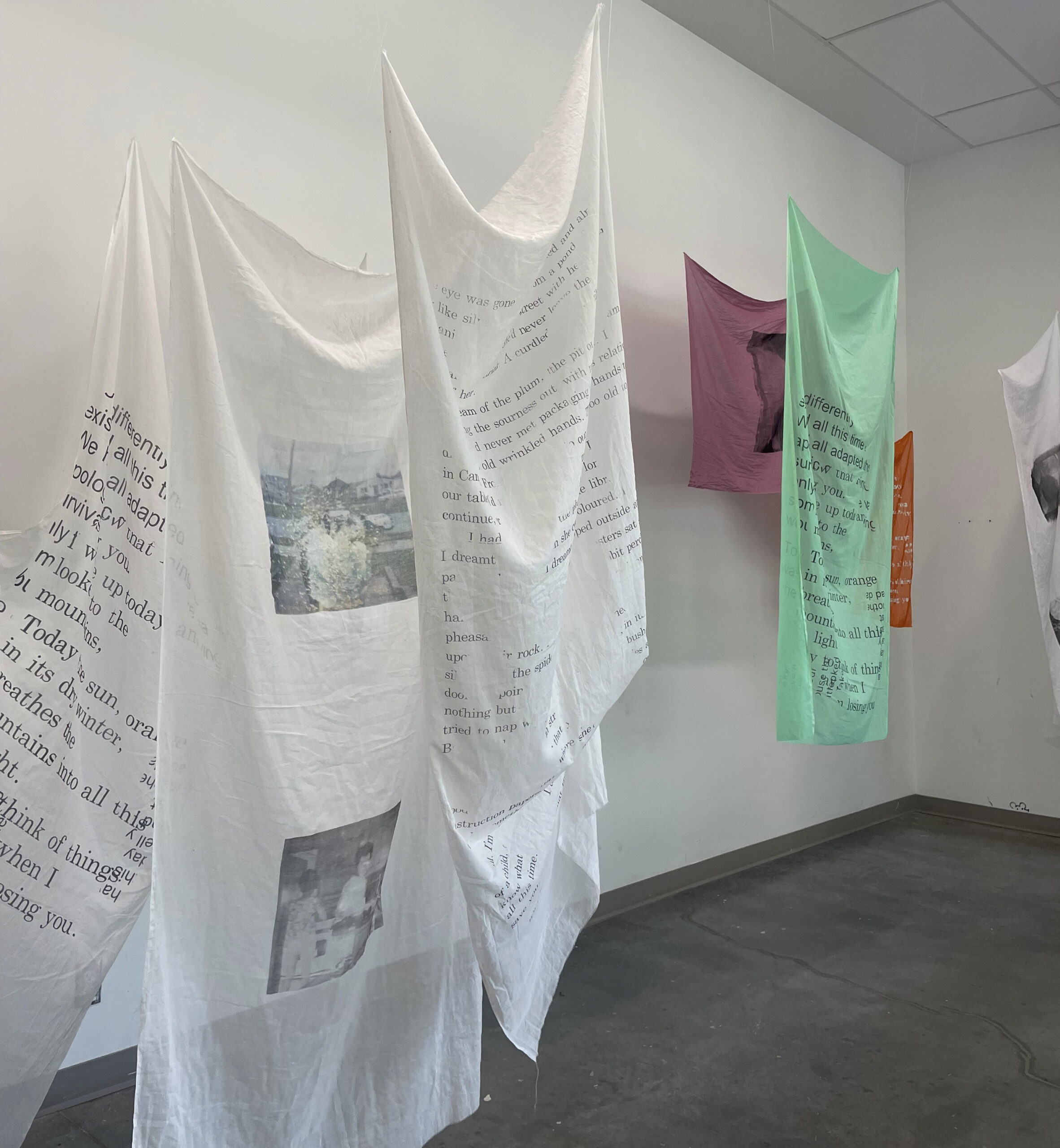
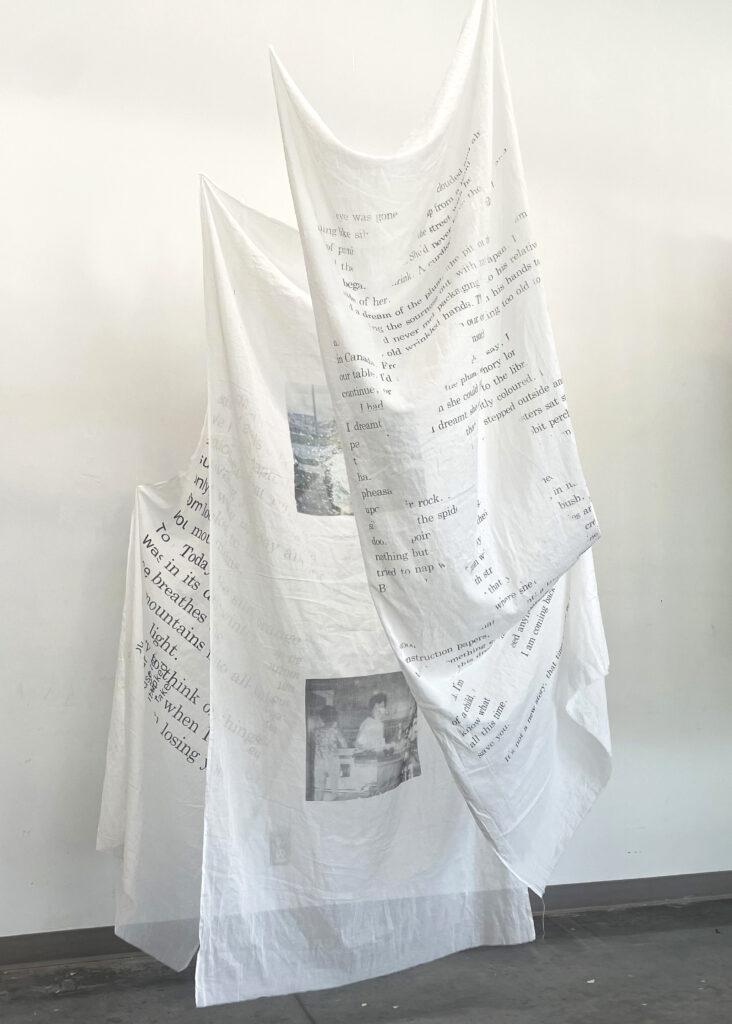
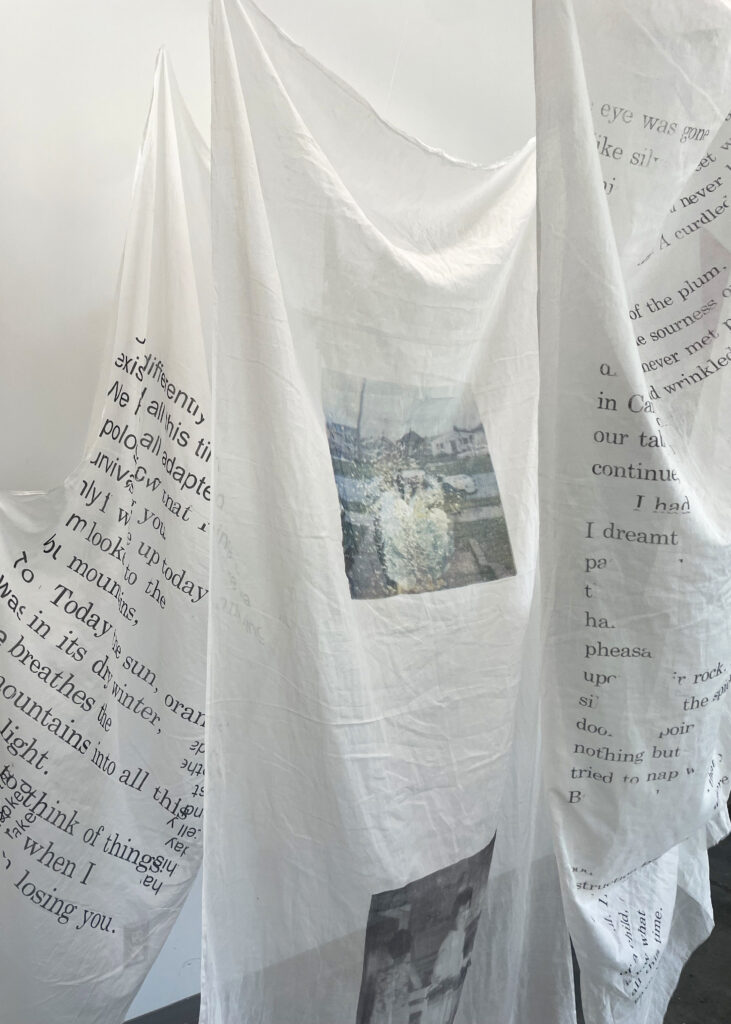
Abunai!, 2025. Serigraph on textile, 3’x5′ per panel.
Abunai! is a series of serigraph prints on textile that translate the personal archive and written practice into an exploration of generational memory. As the elder members of my family age, memory becomes an integral part of preserving stories. I question: what does it mean to navigate the memory, body and brain of someone who is losing these functions? What does it mean to ethically represent this memory while simultaneously protecting its vulnerabilities?
As my grandfather said, once you lose the language, the rest of your culture gets lost very fast. As an urban Indigenous and Japanese Canadian person, I struggled to retain my ancestral languages. Smal’gyax, Gitxaala’s language, was outlawed deliberately and forcibly with the intentions of violently disconnecting the people from their culture. Japanese was slowly lost over generations as further generations stayed and lived in Canada. I retained few words of Japanese as I grew up. Specifically, the word abunai is resonant of my childhood, and is filled with memories of being happy, whether it was running down halls or doing something dangerous. It is a word of caution, a word that is indicative of care.
I come from communities that function on generational mutuality, reciprocity, and the collective building of knowledge. I emphasize that generational knowledge through community is the act of holding together—the glue of marginalized communities. Our knowledge exists outside the Western imposed narrative of who we are—it questions marginalization itself. What are we being pushed to the margins of?
When I write, create, and live, I place my people at the centre of my world, not the margin. When I work with my Ba’s images on textile, I aim to emulate an immersion into Ba’s fragmented world. I’m deeply motivated by Toni Morrison who sets her novels in the centre of her world, refusing to elaborate their context. This contextual level of understanding is only accessible to those who come from that world, although outsiders may still have an experience of the work. My work is building a space for our memories, which is to say it is a world and place in itself. I work with the gaze in my images; the closeness of them is signifying the intimacy and relationality of truly knowing someone.
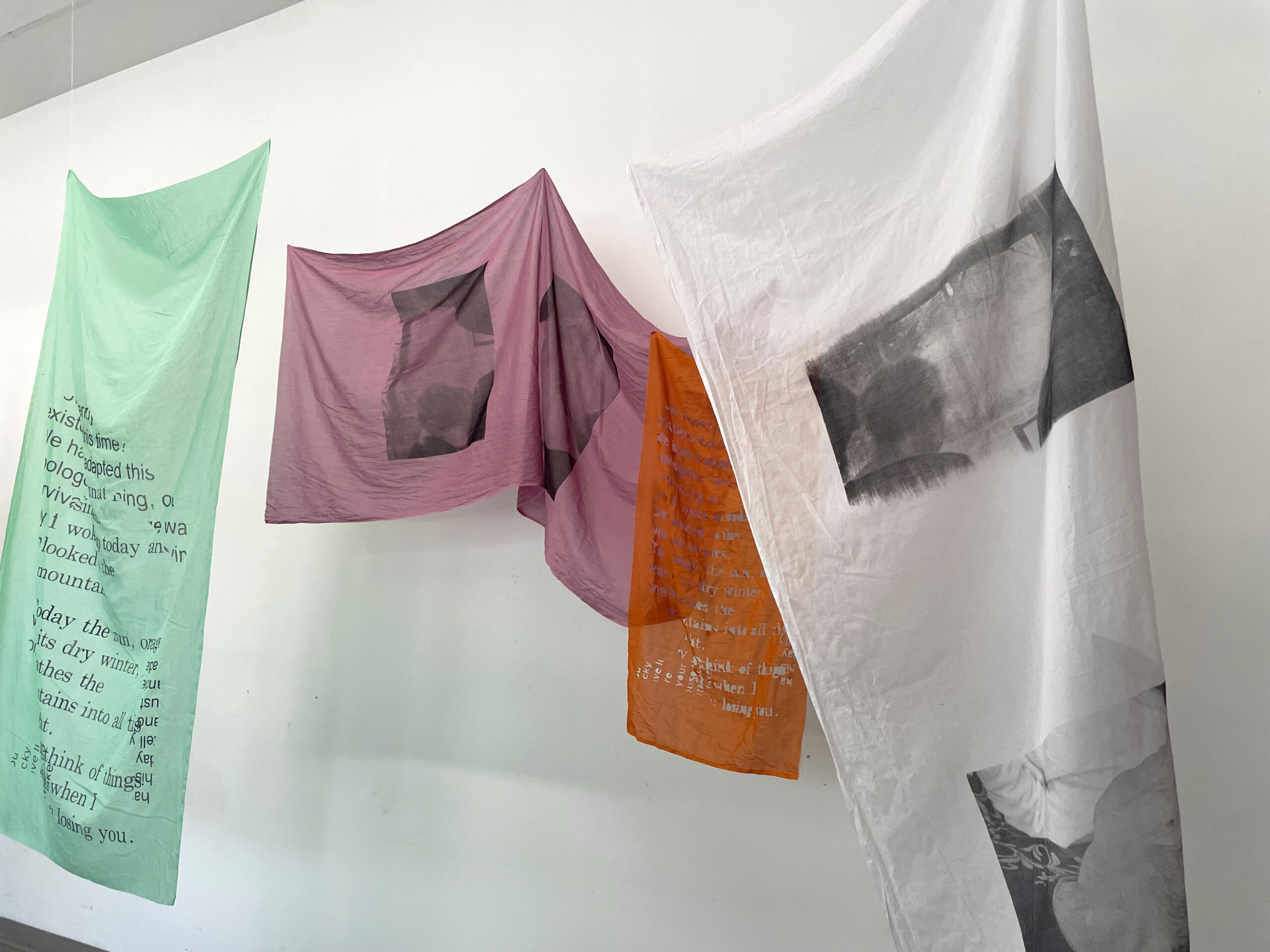
I went through many iterations of creating, through my hands in the slow laborious process of stone lithography, and then through digitizing archive and film photography into serigraphy. I slowly began to realize what I kept unconsciously gravitating towards, and it was my Ba. I was building a body from our collective memories. I was actively grieving and processing the life of someone who is still living. Ocean Vuong writes: “I never wanted to build a ‘body of work,’ but to preserve these, our bodies, breathing and unaccounted for, inside the work.” This body of work is the building of a vocabulary for the words I do not yet have.
Stone Lithography
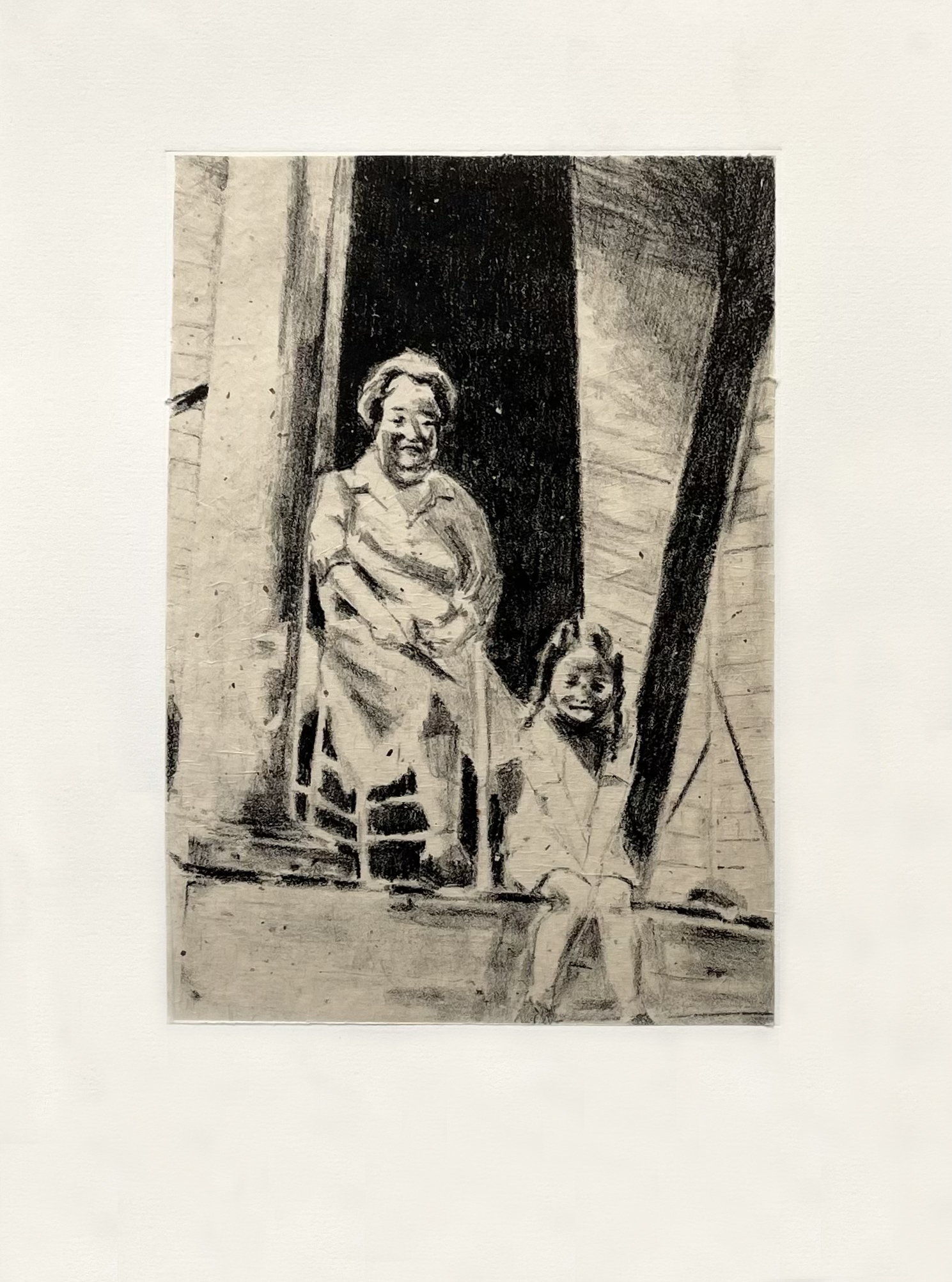
Little Ba, 2024. Stone lithography, chine colle, edition of 10, 11″x15″.
In my lithography work, I directly reference images from my Ba’s archive. More specifically, I reference images that were taken in the Japanese Canadian Internment during WWII. In both Little Ba and Greenwood, I experienced an internal dilemma of ethically representing the images given their context. I knew that I wanted to work with the images by hand, and stone lithography provided a print methodology in which the hand drawn marks from the matrix are directly transferred to the print. In Little Ba, I made the decision to avoid altering the image with interventions of my own. In this photo, my Ba sits smiling on the porch with her own grandmother. The image itself is paradoxical: to me, it represents finding joy and community despite adverse conditions.
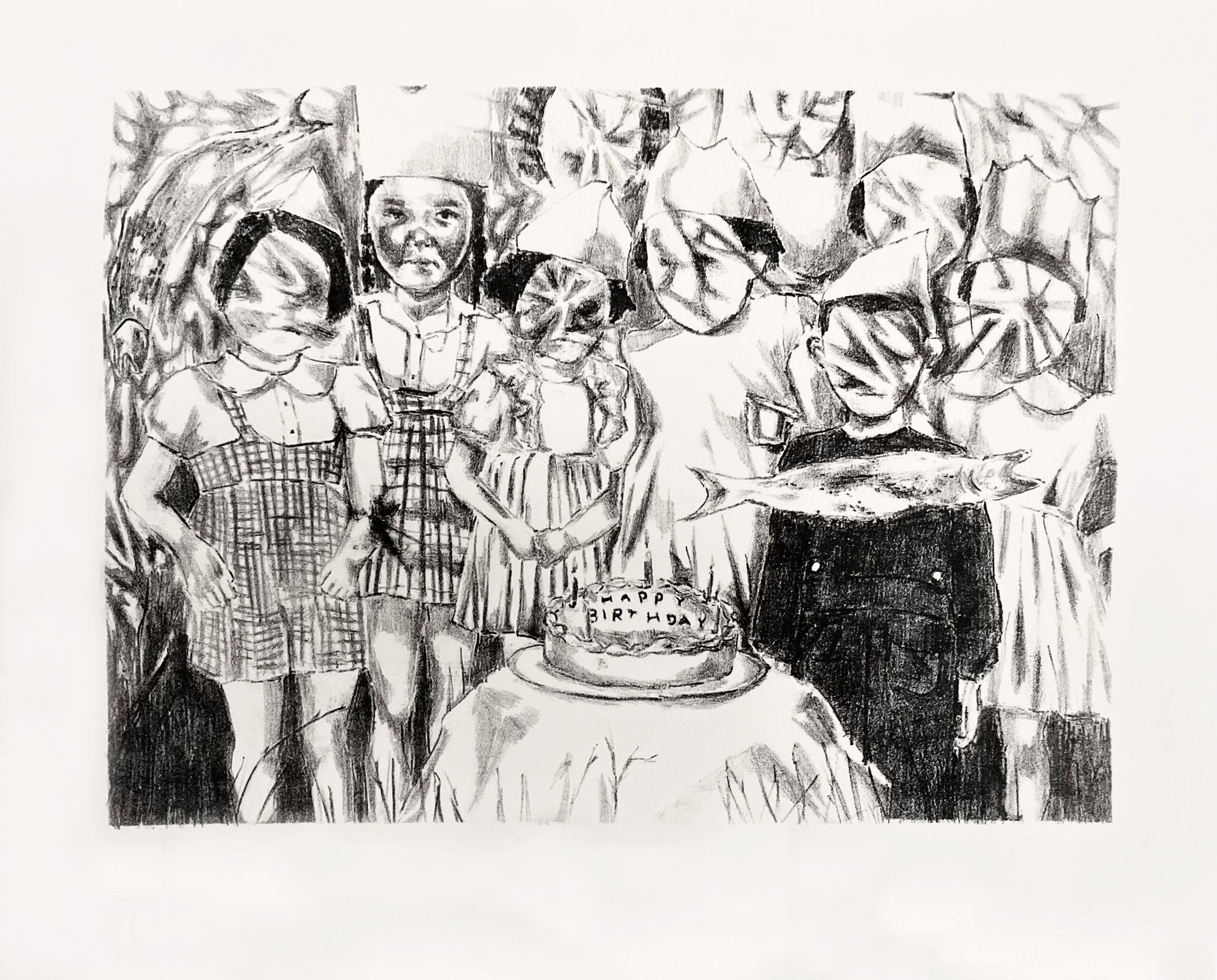
Greenwood, 2025. Stone lithography, edition of 10,
In Greenwood, the original photo is of the Greenwood internment camp kids celebrating a birthday, yet all of them appear to be either stoic or unhappy. This photo came closer to the truth of the living conditions for the Japanese who were interned. I was intrigued by the setting and place in the photo: in the middle of a field. In turn, I took this idea of place and created an unidentifiable space for the subjects to reside in. I wanted to extend the space into the bodies and faces of the kids, as a way to protect their identities, and additionally, extend these people as part of their setting. I confront the viewer with my Ba’s gaze. I was studying Glissant’s essay on opacity at the time and I was thinking of ways to portray an important history while protecting my personal history.
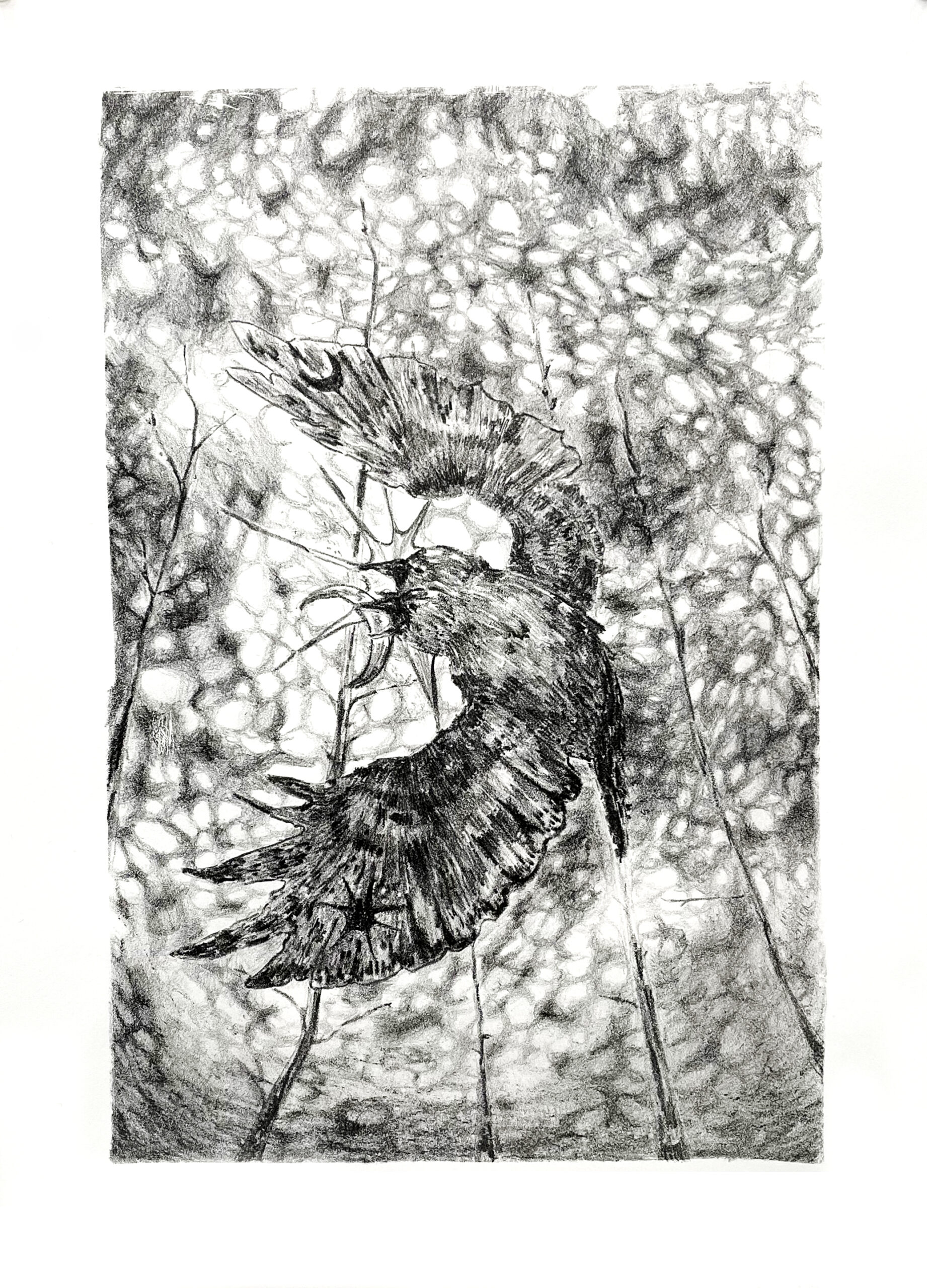
The Double Headed Raven, 2024. Stone lithography, edition of 10, 11″x15″.
The Double Headed Raven is based on a story from Gitxaala Nation, told by my grandpa as follows:
The Double Headed Raven comes out of the ocean during a period of time when both the sun and the moon can be seen in the sky. It has a wing span from island to island. It pulls the water upwards, like a tidal wave about to happen. As it rises from the ocean, it brings an abundance of sea food to the peoples of this world – whales, sea lion, seals, halibut, octopus, seaweeds, variety of salmons, shell fish, crabs, oysters, lobsters, crayfish, and so much more.
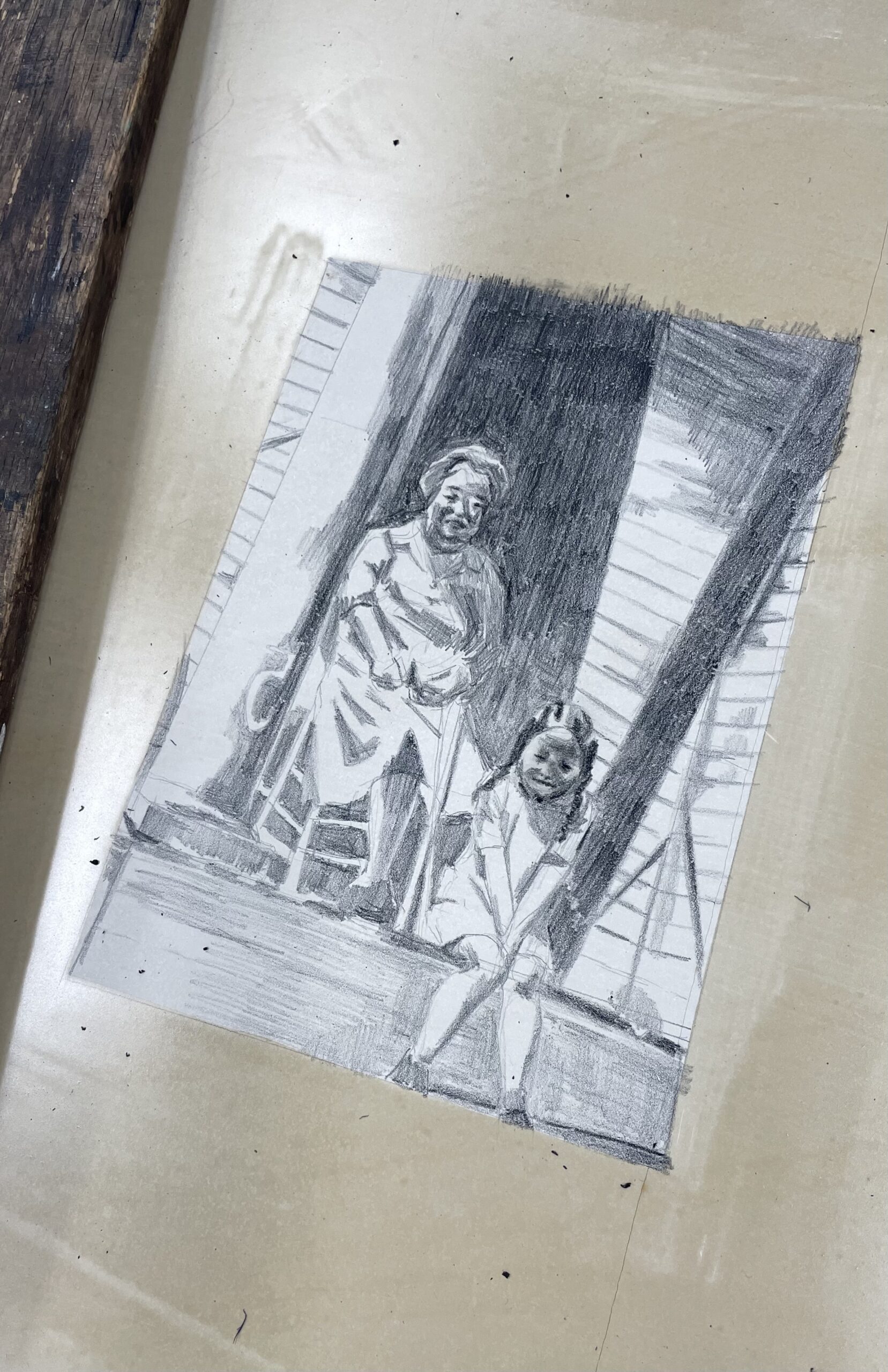
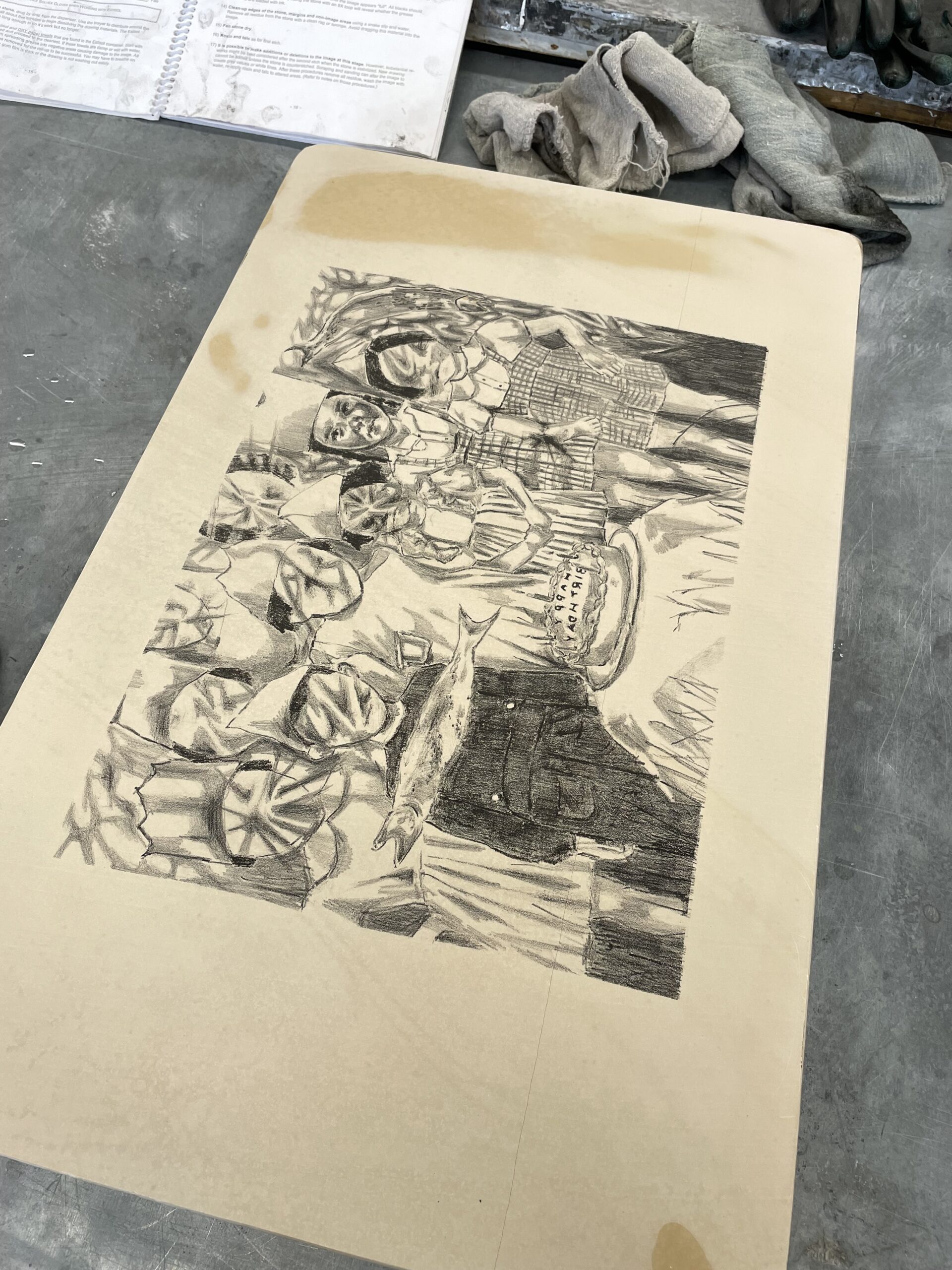
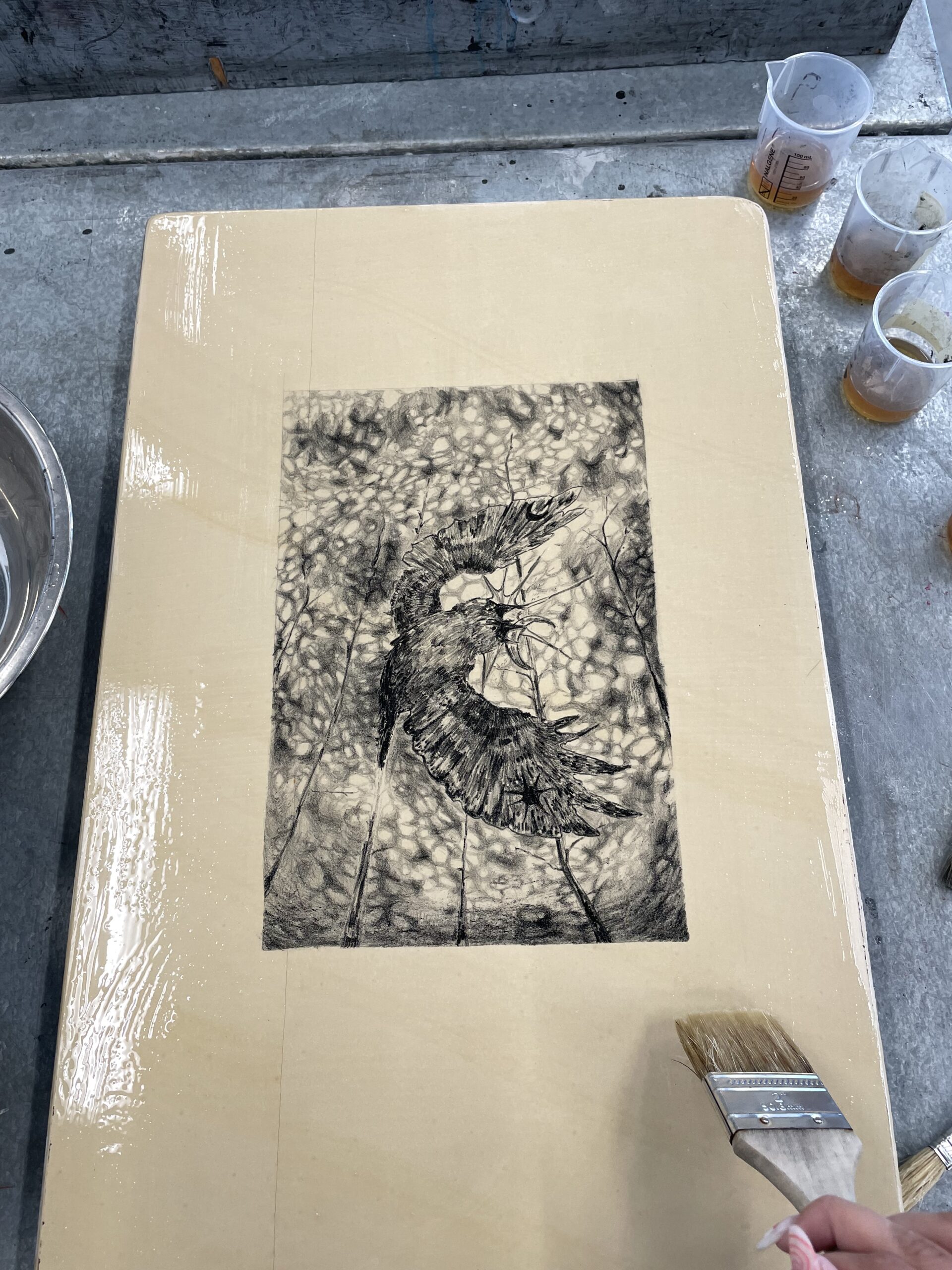
Stone lithography process.
Nikkei
Nikkei: of Japanese lineage (used to refer to migrated Japanese people)
I was specifically invested in examining the housing and the ways of living of my family experienced through past and present. I examine the house as a representation of a specific time or moment. I am interested in the motif of the house as standing for something, whether that be merely shelter, or a more colonial way of ownership. I researched on the history of settlers and Japanese Canadians migrating to Canada, and how the developing houses of settlers indicated an establishment or claim over the land.
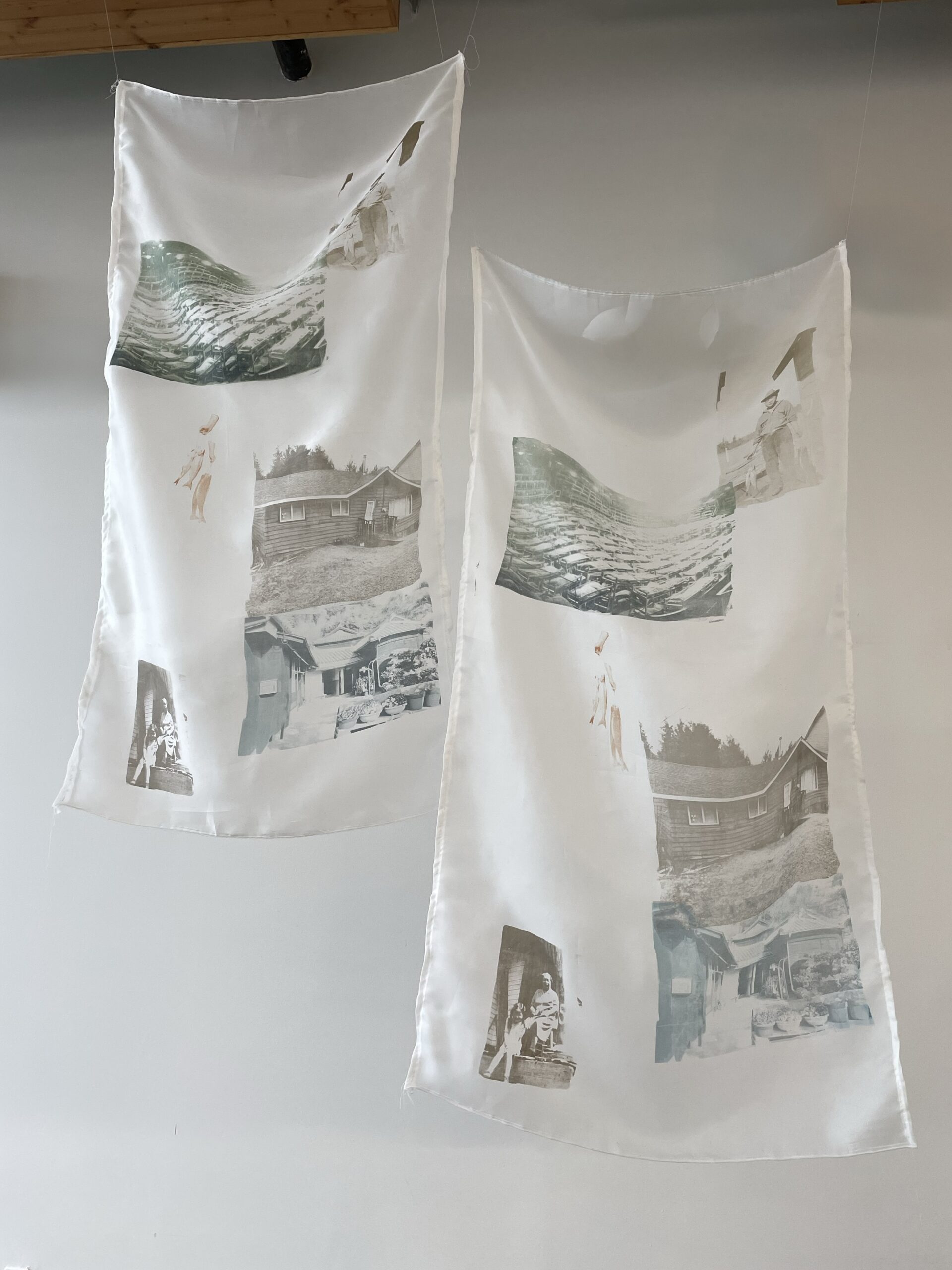
Nikkei, 2024. Serigraph on organza, 3’x5′ per panel.
As a temporary holding measure in the Japanese internment, Japanese Canadians were forced into animal barns. All their houses, boats and belongings were taken, and many Japanese citizens wrote to the government pleading for their belongings to be returned to no avail. In Gitxaala, my grandfather’s house is continuously repaired. Community members struggle with holes in the roofs of their elderly citizens. In the wake of settler colonialism, Indigenous people around the world have already survived an apocalypse of sorts. The apocalypse is not a futuristic concept but a current reality for many. The system and residue of colonialism is killing my family and my people every day. There is a multiplicity in this oppression: this is a history of taking. I want to emphasize that Canada is complicit in many disparities. My identity allows me to examine this complicity through two lenses: through the lens of an immigrant family, and an indigenous family. Through both lenses, I can clearly comprehend that Canada has destroyed the sovereignty of several marginalized communities through colonial framework, although it attempts to advertise itself as inclusive.
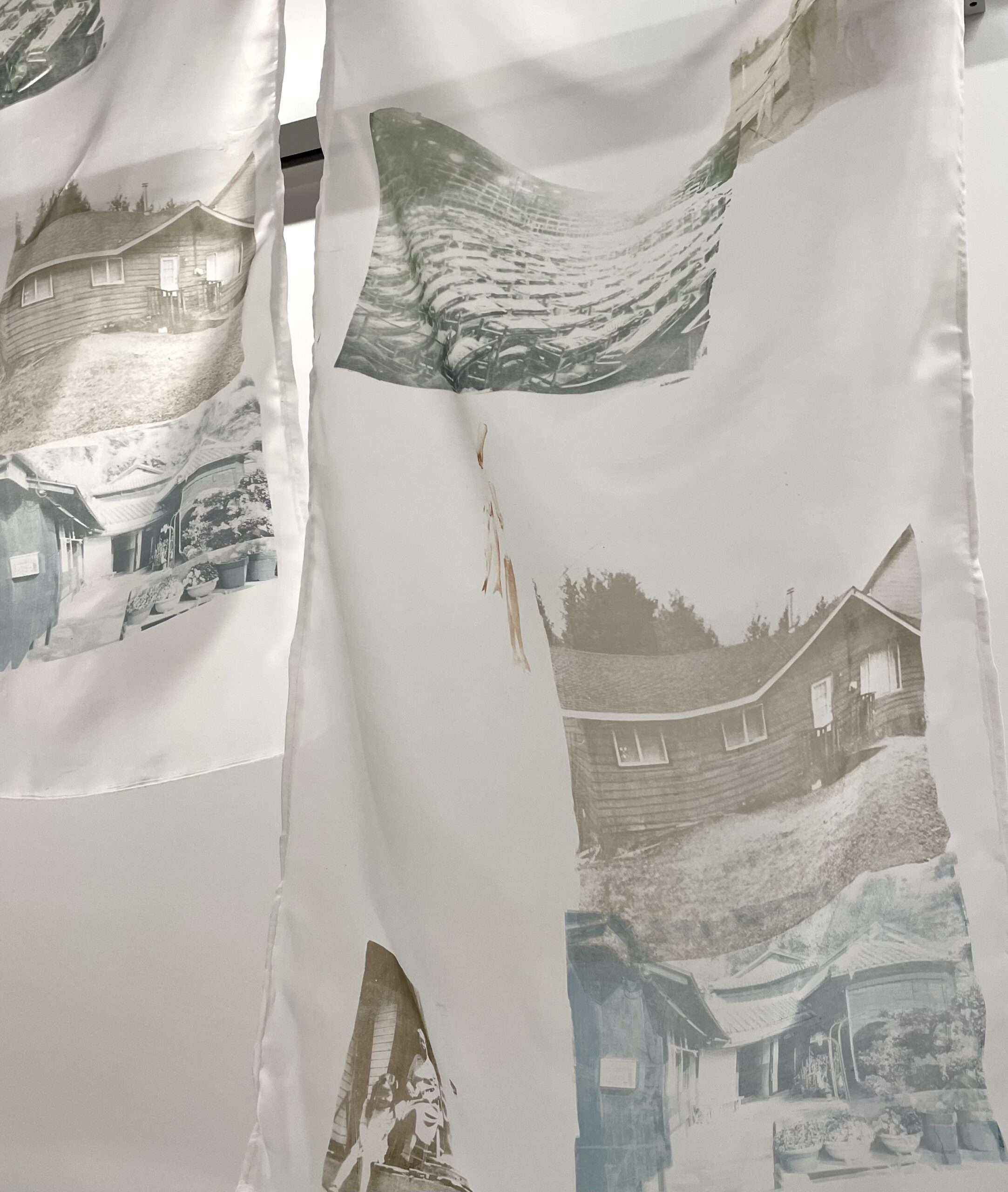
The images in this piece are taken from the archive of my grandmother and relatives who had photos of the beds laid out for Japanese people,—temporary spaces as they were taken from their houses—crowded together in a Vancouver animal barn. I also include images of my grandfather’s home in Gitxaala, and my ancestors’ home in Mio, Japan. I highlight the salmon as a resource that many Indigenous and Japanese families were dependant on post WWII, including the elders in my family who worked in fish canneries.