A bud, a seed, parts unrecognized
Mikayla Sousae
See it On Campus: Level 1
A bud, a seed, parts unrecognized
To rupture, to rearrange
A trace of a past self
An empty shell
Without beginning or with only beginnings
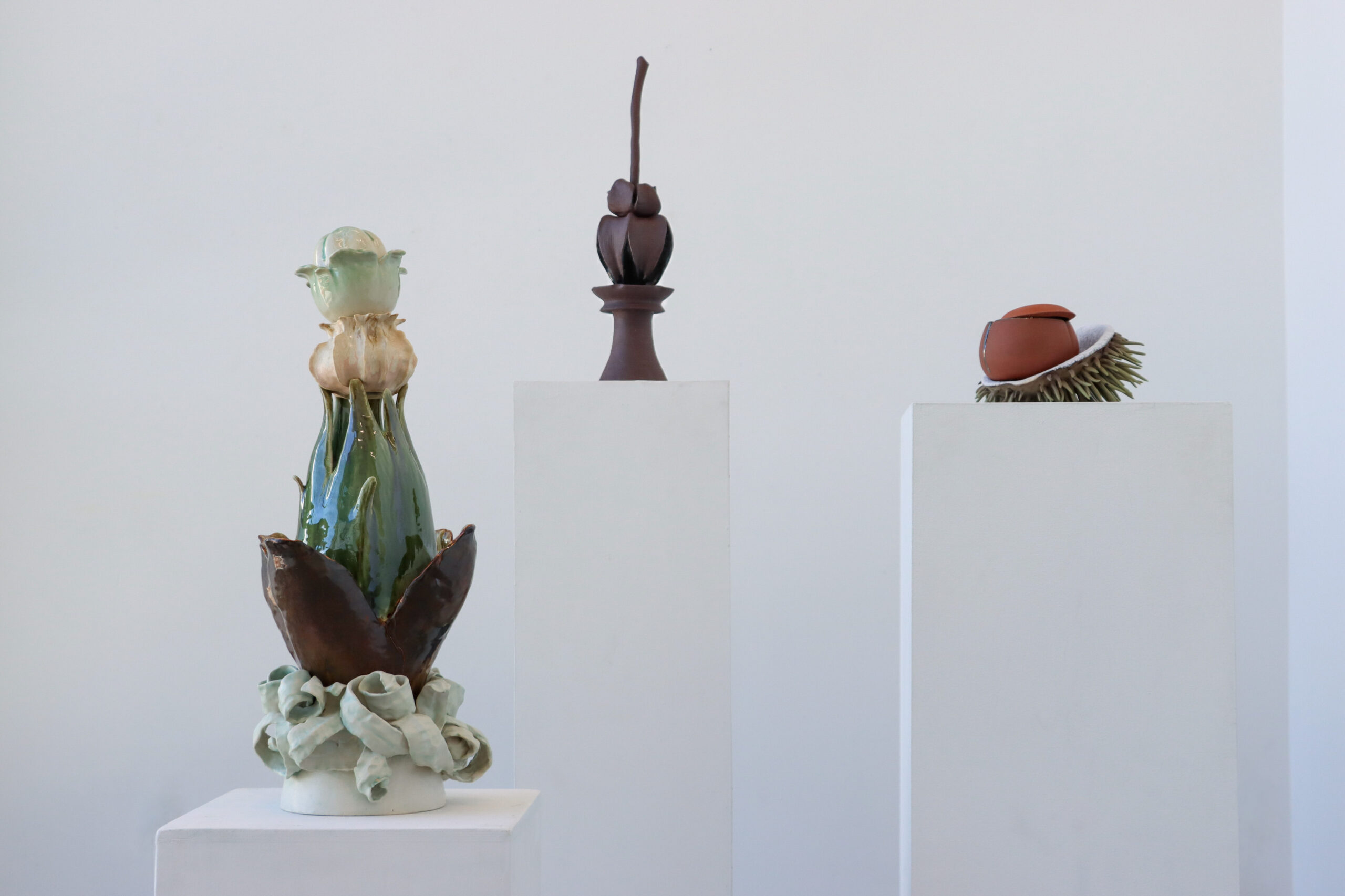
Installation view of A bud, a seed, parts unrecognized. Emily Carr University, 2025.
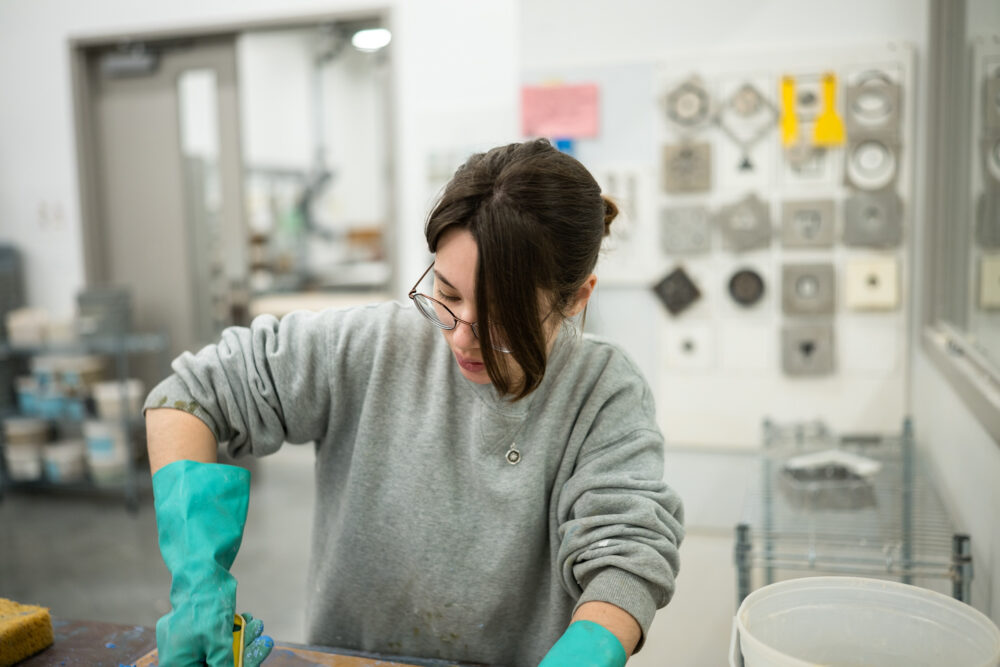
As part of my my last semester of Critical and Cultural Practice at Emily Carr, A bud, a seed, parts unrecognized looks at the vessel, both in nature and in ceramics, through three specific seed pod case studies. From an initial observation, my relationship with each developed through information gathering, scanning, drawing, writing, and most importantly, playing with clay!
Through this material practice, I am interested in questioning of our perception of self, death and change. These shedding vessels hold no specific beginning or end, require building pressures, rupture, and rest. I often come back to moments in Karen Barad’s text What is the Measure of Nothingness? where she discusses the void through a quantum physics lens. “At the heart of quantum physics is an inherent ontological indeterminacy”, she says. I have been thinking about her notes on the agency of measurements and matter’s constant negotiation between non/being and un/doing. When I am researching, how am I and the plants changing each-other? How does their non/being and un/doing destabilize their sense of self and rethink ideas of loss?
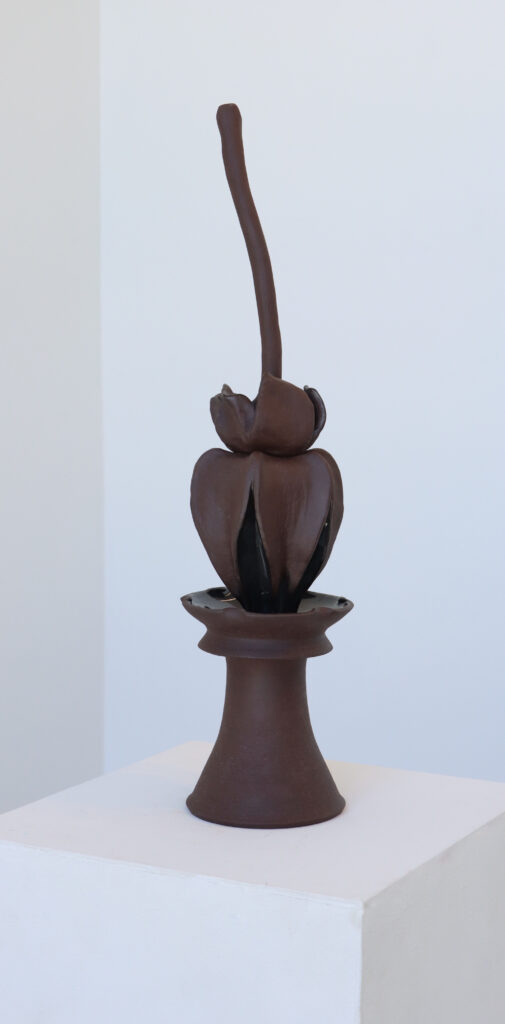
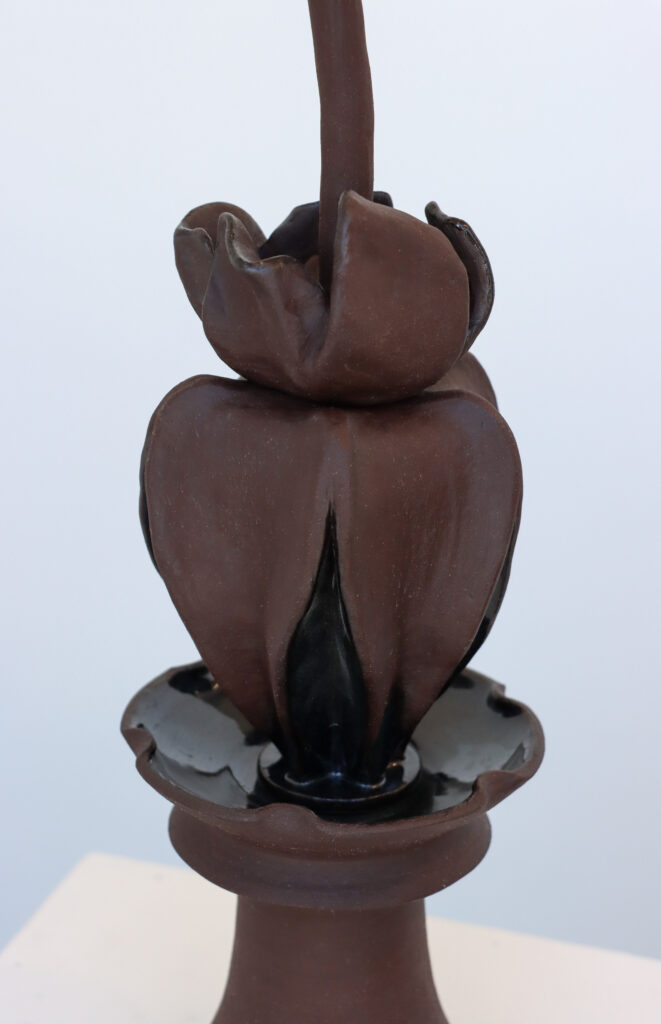
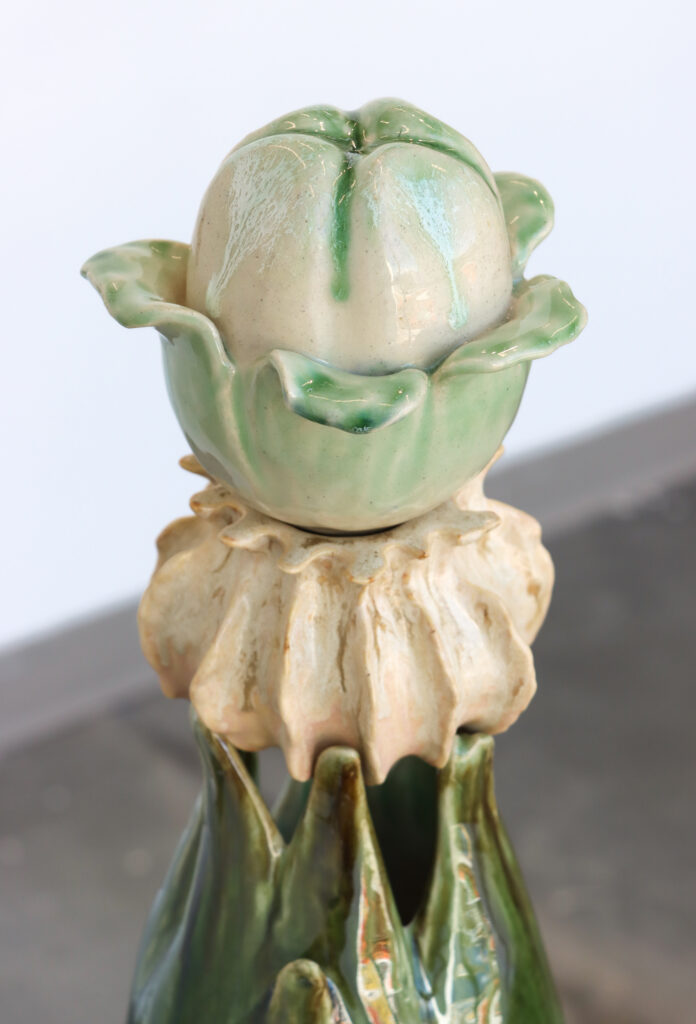
The first piece, Vessel for Resting (Stewartia), melds the form of a found Stewartia tree seed pod with that of a 17th century Chinese three part ceramic urn. The hollow capsule sits on a wheel-thrown base and is lidded by its delicate stem.
The urn holds the body as it does grief and uncertainty, it is a space of rest that is often transient. In reading that the seeds of the Stewartia are doubly dormant (they require two cold periods before sprouting) I wondered about the ways in which the urn may also hold change, dispersal and future growth.
Vessel for Resting (Stewartia), ceramic, 5″ x 24″. 2025.
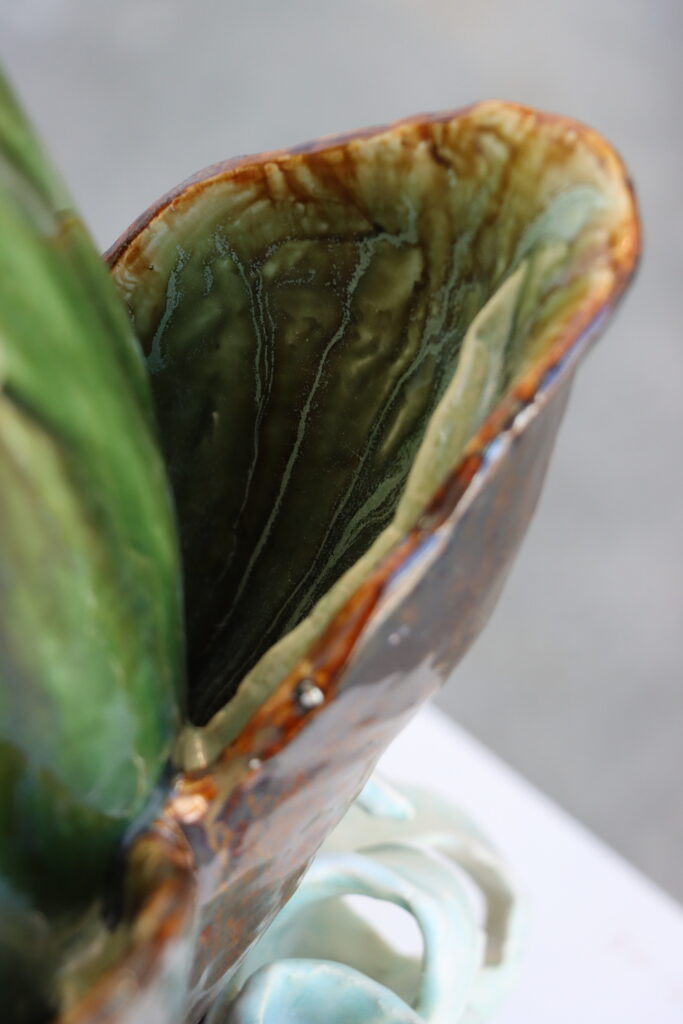
The second piece, Hybrid (Chestnut), takes inspiration from chestnuts and the spiky burrs they grow in.
In the early to mid 1900’s the American Chestnut population was nearly decimated by an invasive fungus. As a response, the species has been crossbred with the Chinese Chestnut for its resistance.
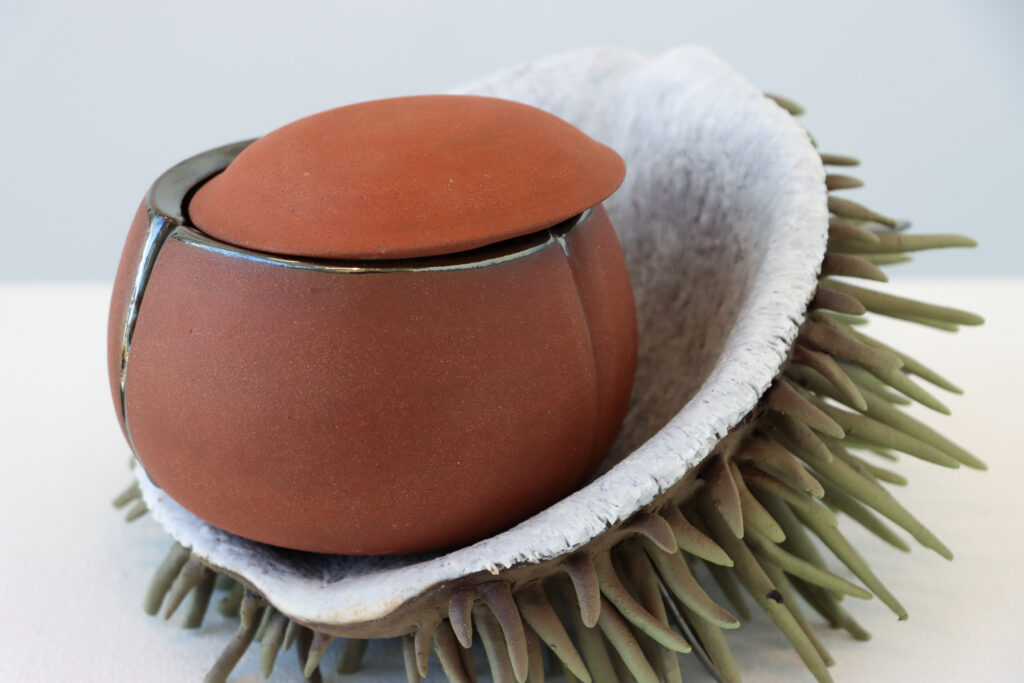
Hybrid (Chestnut), ceramic, 1′ x 1′ x 8″. 2025. (Sold)
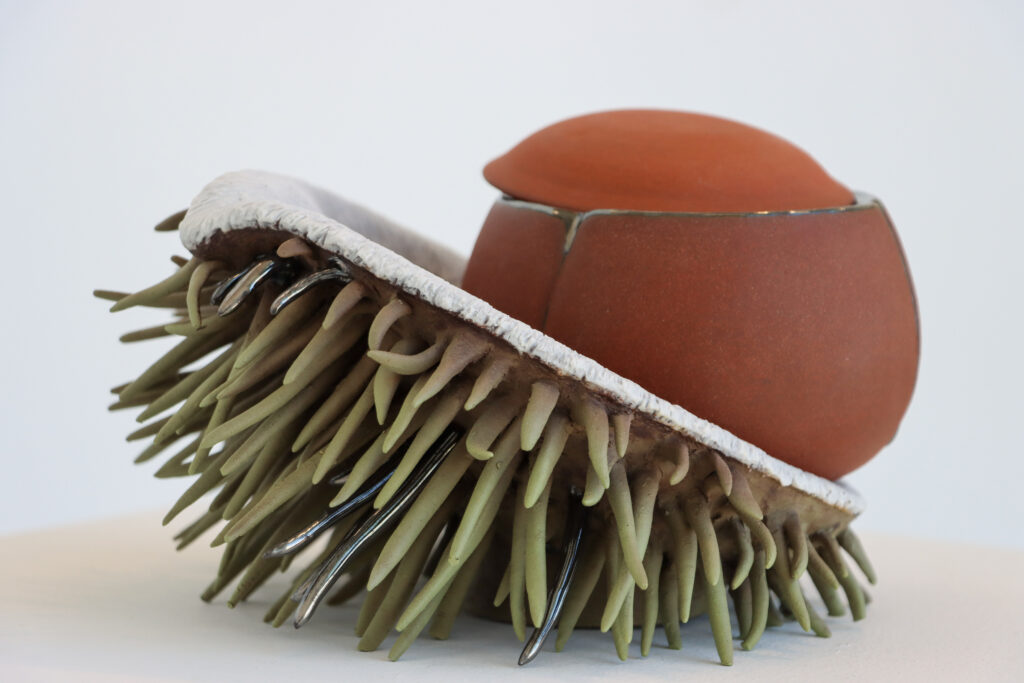
The addition of palladium glaze on the vessel’s lip and select spikes speak to this history of hybridization and manufactured restoration.
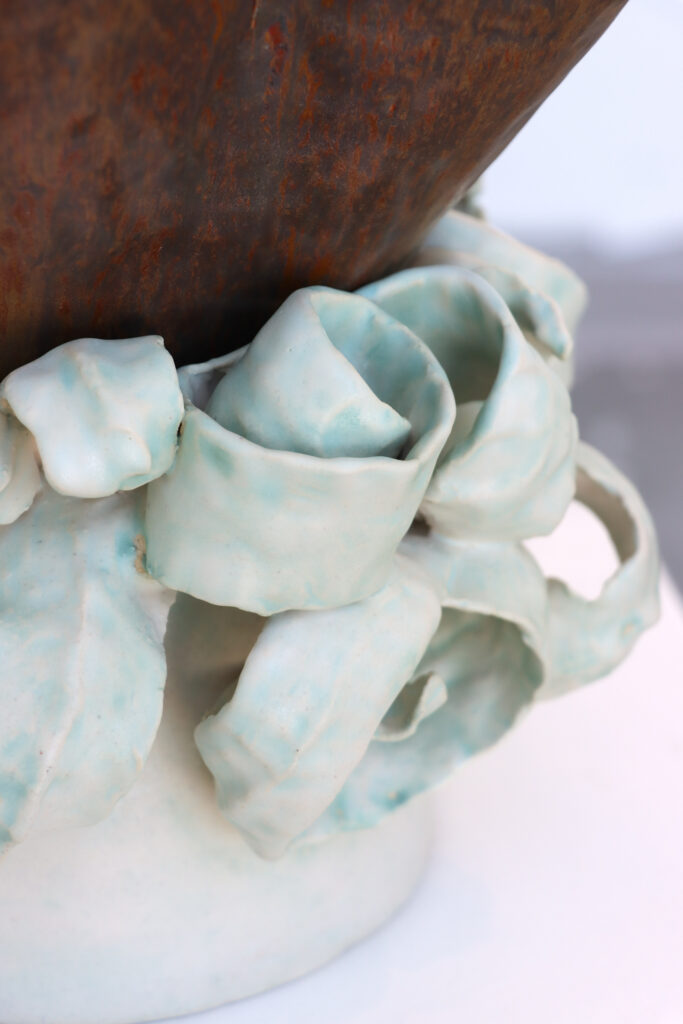
The last case study, To Rupture, to Rearrange (Witch Hazel), brings together four vessels in a vertical balance.
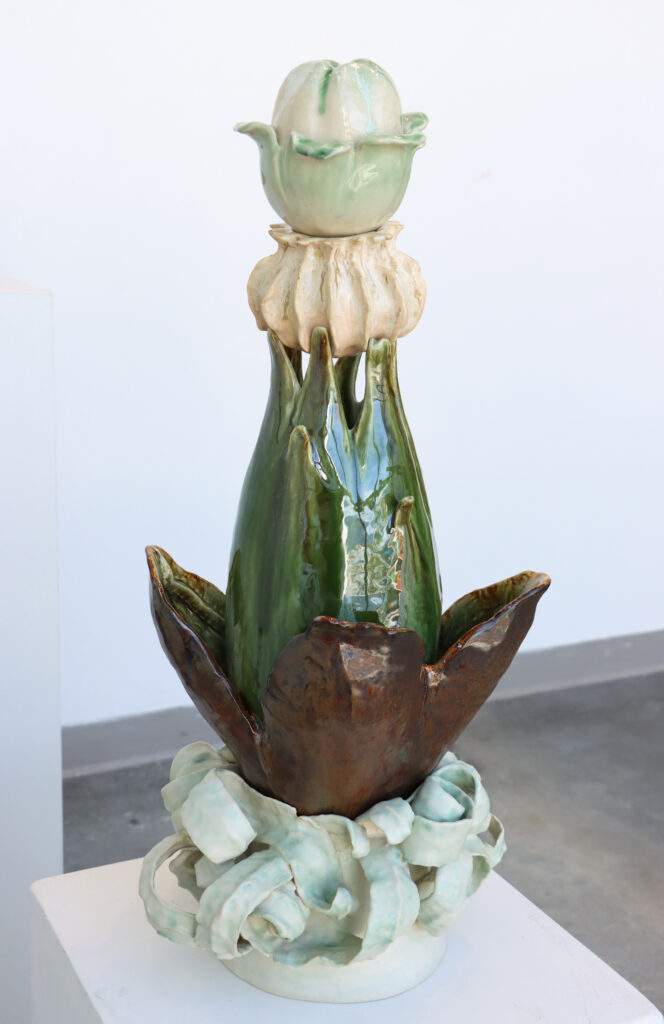
To Rupture, to Rearrange (Witch Hazel), ceramic, 1′ x 1′ x 32″. 2025.
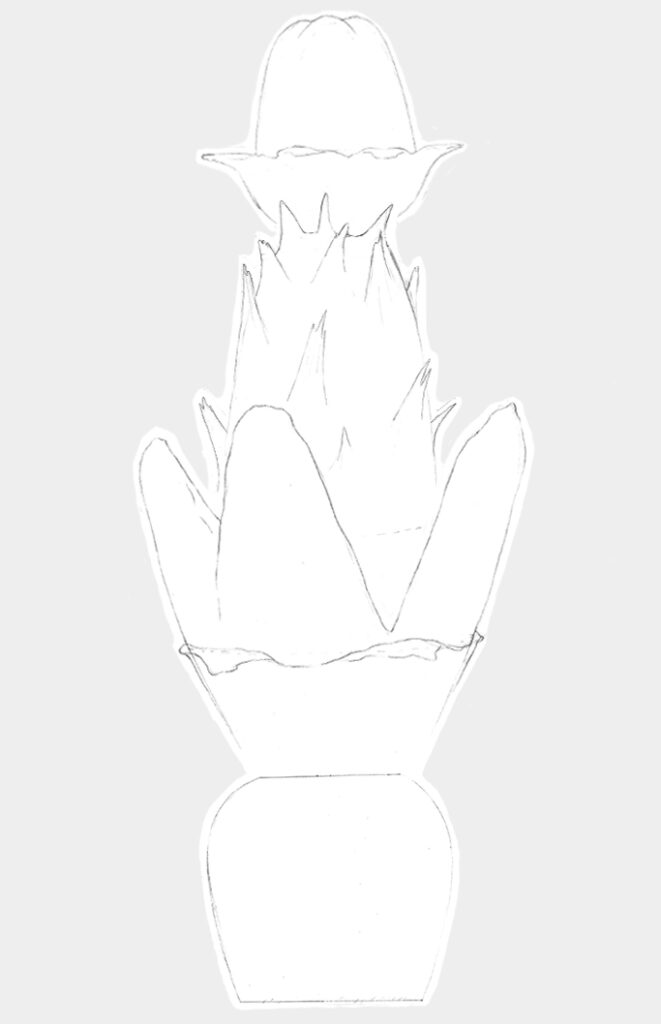
Drafted plan for To Rupture, To Rearrange (Witch Hazel), 1′ x 3′. 2025.
I was first struck by witch hazel’s long ribbon-like yellow petals. As time passes, their tight curls unravel and stretch outwards. In further research, I found that the pod uses a kind of pinching mechanism to shoot out its seeds up to 30′ out. The four symmetrical flaps represent this significant release of built up energy and its resulting ruptured pod. It opens up to hold itself at past and future times, in both expected and alien ways.
With its modular form, the work seeks to investigate the relation between each of these four forms as they hold, transform, and push against each other.